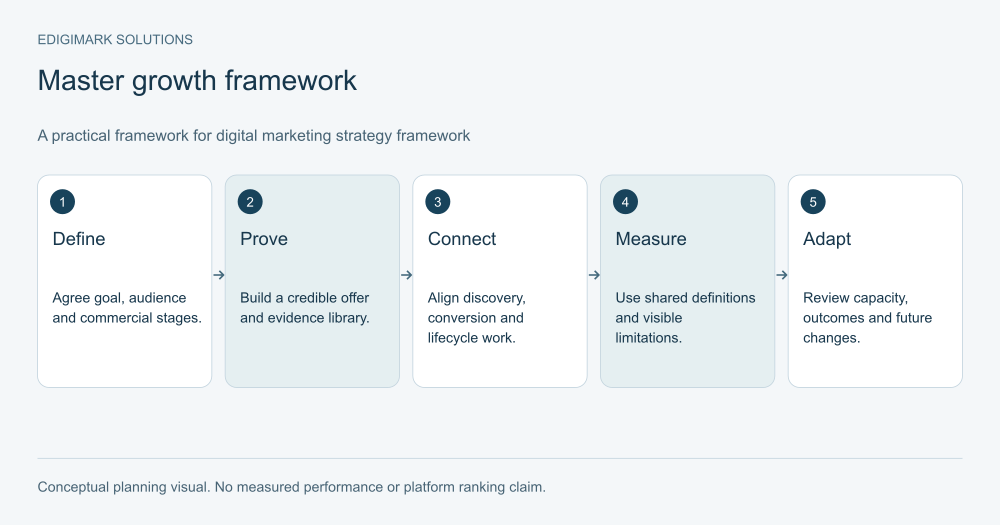
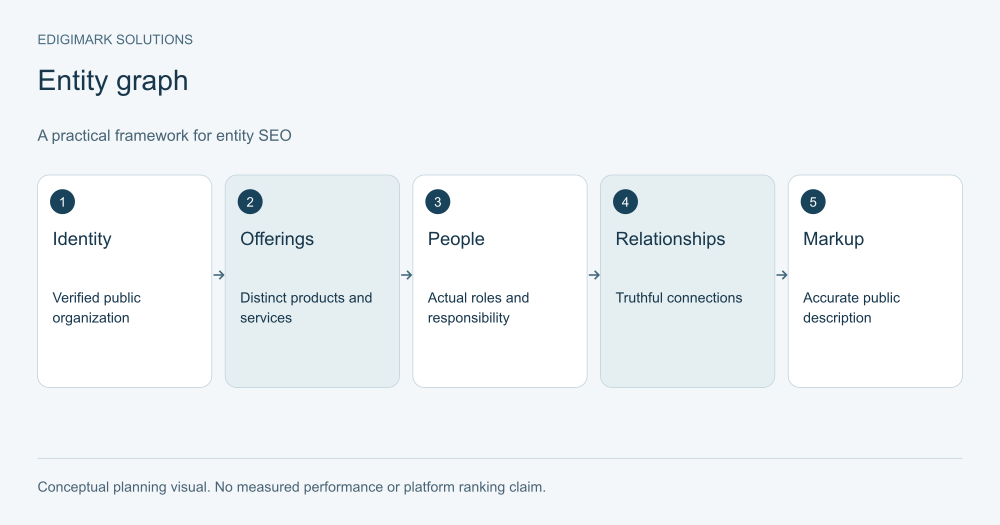
Entity SEO focuses on making the identity of a brand, product, person or service clear and explaining its real relationships. Start with accurate public information, consistent naming and useful context, then implement appropriate structured data where it applies. The objective is clarity and disambiguation, not a promise that markup will create a knowledge panel or an AI recommendation.
An entity is a specific thing, while a keyword is language someone uses to find information. A company can be described by many phrases but still has one public identity. Confusing those ideas can lead a business to publish inconsistent names or treat repeated wording as a substitute for reliable facts.
In this guide
- How does entity SEO differ from adding related keywords?
- What does brand entity optimization begin with?
- How should products and services be distinguished?
- How do people and expertise fit the entity picture?
- What should entity relationships communicate?
- What does organization schema contribute?
- How should sameAs references be used?
- What should an entity consistency audit inspect?
- How do you plan an entity information model?
- What does a worked entity SEO example look like?
- How do you avoid entity-related overclaiming?
- How should entity information support content planning?
- How should an entity SEO review measure information consistency?
- What should an entity information maintenance process include?
- How should entity SEO distinguish several brands or offerings?
- What should an entity SEO implementation handoff contain?
- How do you review entity consistency with a manageable audit?
- Frequently asked questions
- Make the identity and offer easy to understand
How does entity SEO differ from adding related keywords?
Related keywords can describe a topic, but entity relationships explain who does what. A software product belongs to an organization, serves particular tasks and may connect with specific systems. A service has an actual scope and responsible provider.
The useful work is to make those relationships accurate and understandable. A page that lists technology names without explaining their role may add vocabulary while leaving the reader confused.
For a hypothetical company called Example Workflow, the organization, its software product and its implementation service are different subjects. The website should not use their names interchangeably. A product capability claim should not become a claim about every consulting engagement.
Consistency protects understanding. It does not mean repeating the full company name in every sentence. Use the precise subject where ambiguity matters and natural references where the context is clear.
What does brand entity optimization begin with?
Create a verified identity record. Include the public name, official website, appropriate contact details, actual service descriptions and profiles the organization legitimately maintains. Identify who owns corrections.
Check important pages against that record. The homepage, service pages, contact information and relevant profiles should not contradict one another. A rebrand or changed service scope can leave old descriptions scattered through the site.
Resolve ambiguity with truthful context. If another organization has a similar name, explain your actual specialty and identity clearly. Do not invent a location, credential or relationship to make disambiguation easier.
Keep administrative and public destinations distinct. A CMS host is not necessarily the public website. Metadata and structured data should represent the actual resource and organization according to the intended implementation.
How should products and services be distinguished?
A product description should state its current purpose and verified capabilities. A service description should state what the provider does, which prerequisites exist and what is excluded. These may connect, but they should not collapse into one vague promise.
For example, a connector may support defined records, while a professional CRM integration engagement can include planning and implementation work under a specific scope. The website should explain which claim belongs to the product and which belongs to the service.
Use stable labels for important offerings. If several names refer to the same service, explain the relationship rather than letting pages appear to describe separate offers. If they are distinct, state the difference.
Review changes with the owner of the offer. A writer should not infer capabilities from an outdated proposal or a competitor’s terminology. Identity clarity begins with verified business facts.
How do people and expertise fit the entity picture?
Represent actual authors, reviewers and responsible people accurately. A role description should reflect real involvement. Do not create fictional biographies, credentials or headshots to make content look more authoritative.
Where a person reviews a technical section, record what they checked. Their involvement may be narrower than authorship or full endorsement. The public description should not exaggerate that responsibility.
Connect expertise with specific information. A process explanation or verified example shows more than a generic label saying the team is expert. The reader needs to understand why the advice is applicable.
Maintain people-related details when roles change. An outdated profile can create confusion about accountability even when the article’s facts remain correct.
What should entity relationships communicate?
Explain actual connections: organization and product, service and task, person and responsibility, resource and subject. A relationship should help the reader understand scope or evidence.
Do not infer a partnership from a mention or a link. A page can discuss a technology without implying official certification or endorsement. Use relationship language only when it can be substantiated.
For an automation article, the useful relationships may be between a source system, a destination system, record ownership and a workflow. Explain those operational connections rather than adding a decorative network of unrelated logos.
A visual entity graph should be labeled conceptual if it illustrates a model. It should not imply that a search engine stores exactly the same graph or recognizes every proposed relationship.
What does organization schema contribute?
Google’s Organization documentation explains that appropriate organization structured data can help with administrative details and disambiguation. Implement relevant truthful properties, and keep them aligned with the public information.
Schema is a description mechanism, not an evidence generator. An unsupported claim remains unsupported when placed in markup. A fabricated address or profile does not become legitimate because a validator accepts the syntax.
Review which system outputs organization information. A CMS plugin and a frontend template may both produce it. Conflicting names, URLs or identifiers need correction with the website owner rather than another layer of markup.
Inspect the public result after implementation. A field saved in an administration panel may not reach a separate frontend. Use observable acceptance checks for the delivered structured data.
How should sameAs references be used?
Schema.org defines sameAs for a reference that unambiguously identifies the same item. Use it carefully. A related company, a general directory category or a page merely mentioning your brand is not necessarily the same entity.
Prefer references that accurately identify the organization and that you can verify. Do not add unrelated destinations to make the list longer. The property should express identity, not a collection of promotional associations.
Keep the referenced URLs current. A deleted profile, changed handle or transferred account can alter the meaning of a reference. Review these links during identity updates.
Distinguish same identity from a relationship. A product’s integration with another system should not be expressed by claiming both systems are the same thing. Choose an appropriate factual description rather than forcing every connection into one property.
What should an entity consistency audit inspect?
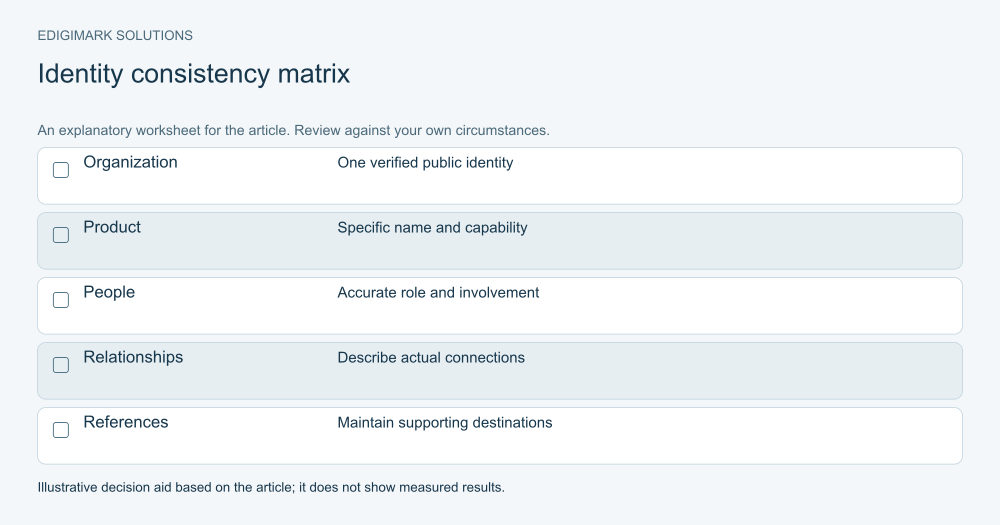
Review the following fields with the responsible owner:
| Information | What to compare | Reason |
|---|---|---|
| Public organization name | Website and maintained profiles | Avoid identity contradictions |
| Official website | Metadata and structured data | Identify the intended public organization |
| Service scope | Articles, service pages and proposals | Keep capability claims aligned |
| Product names | Documentation and commercial pages | Distinguish products from services |
| People and roles | Authorship and review descriptions | Preserve actual responsibility |
| Reference URLs | Relevant profiles and identity records | Maintain valid identity connections |
The audit should capture specific discrepancies. “Improve entity signals” is vague. “The public service page uses an old product name while the current documentation uses the new name” gives an editor a concrete correction.
How do you plan an entity information model?
Start with the subjects the business actually needs to describe. Name the organization, offerings, responsible roles and important resources. List the relationships readers need to understand.
Decide which page owns each explanation. The organization overview can explain identity; a service page can explain scope; a product reference can explain capability. Supporting articles can link to those owning resources rather than restating inconsistent summaries.
Keep the model simple enough to maintain. A large technical graph is not useful if the team cannot verify its facts or understand why each relationship exists. The practical model should support content and implementation decisions.
Use web development when metadata or structured-data delivery needs technical work. Provide the verified record and expected public behavior, then check the actual response.
What does a worked entity SEO example look like?
Imagine a hypothetical business with a product called RouteDesk and an implementation service. Some pages call the product a CRM, others call it a routing tool and a profile claims the company offers every type of software integration. Buyers are unclear about the actual offer.
The company first verifies the product purpose and service scope. It creates consistent descriptions: the product handles defined routing tasks, and the service supports scoped implementation. Unsupported broad claims are removed.
The organization page, product resource and service page each own a distinct explanation. Articles use the right subject and link to the relevant owner. Organization markup and identity references are checked for agreement with visible information.
The outcome of this exercise is clearer public information. The example does not claim that a search service creates a knowledge panel or improves rankings. Those remain separate observations to assess with available evidence.
How do you avoid entity-related overclaiming?
Do not promise that adding markup will establish authority or force recognition. Avoid treating every third-party mention as an identity signal you can control. Search and assistant systems have their own selection processes.
Do not create false profiles or inauthentic references. A credible information model uses actual facts and legitimate relationships. Manufacturing identity evidence can undermine the trust the work is meant to support.
Google’s structured-data policies are a primary reference for accurate markup implementation. Review applicable requirements rather than assuming any valid schema is appropriate for the page.
Keep the purpose human-readable. A buyer should understand the organization and offer from the visible page. Hidden data should support that explanation, not contradict or replace it.
How should entity information support content planning?
Use the model to distinguish topics and owners. A product comparison can discuss product facts; a service guide can discuss implementation responsibilities; a company page can discuss the organization’s actual focus.
It can also identify missing context. If articles repeatedly mention a service with no clear scope resource, the owning page may need improvement. If a person is credited without an accurate role description, fix the responsibility record.
Connect the work with digital marketing so the public identity supports the audience and offer you want to serve. Identity consistency is most useful when it reduces confusion across the customer journey.
For related systems work, marketing automation can be relevant where the page explains actual workflow needs. Avoid using the entity model as a reason to insert every service into every resource.
How should an entity SEO review measure information consistency?
Start with verified corrections: consistent names, accurate scope, maintained references and aligned public markup. These are observable information improvements. They should not be relabeled as a private search-engine score.
Review customer understanding and inquiry fit where possible. Are fewer people misunderstanding the product’s purpose or service coverage? Keep qualitative feedback distinct from analytics counts.
Use data analytics to inspect relevant website actions and source observations. A change in branded activity may be interesting, but it does not by itself prove that schema caused the movement.
Maintain the evidence and change dates. A rebrand, campaign or product release can influence several observations. Report what is measured and identify what remains inferred.
What should an entity information maintenance process include?
Give the identity record an owner and event-based review triggers. Rebrands, new offerings, changed roles and updated contact information should prompt checks across affected pages and markup.
Track where important facts appear. The dependency record can be small: fact, owning page, related pages and output system. This helps the team update public information coherently instead of correcting one field at a time.
Verify the delivered website after changes. Check visible descriptions, metadata and applicable structured data. Keep administration changes separate from public verification status.
How should entity SEO distinguish several brands or offerings?
First identify the actual relationship. A product name, trading brand, subsidiary and service package can describe different things. The website should state the relationship accurately rather than treat every label as interchangeable.
Give the reader enough context to understand responsibility. Which organization provides the service? Which product does the article discuss? Where can the user find support or commercial scope? These answers matter even before any technical markup is considered.
Maintain separate descriptions when the subjects differ, and a shared identity reference where they are truly the same. A developer should not have to infer corporate or commercial relationships from similar names. Supply a verified information model and obtain the appropriate business owner’s review.
Do not create elaborate public claims that the business cannot substantiate. If a relationship remains unclear internally, resolve it before publishing a confident description. The entity review can reveal an information-management problem that precedes SEO implementation.
What should an entity SEO implementation handoff contain?
Provide the verified identity record, owning pages, relevant relationships and the system responsible for each public field. Include actual reference URLs and exclude speculative profiles or unverified identifiers.
State acceptance checks for visible information and technical output separately. The company description should be accurate and readable. The applicable markup should agree with it and avoid conflicting output from multiple systems. Both need public verification.
Include known exceptions. A service may have a narrower geographic scope than the organization, or a product may use a different support destination. Those distinctions should not be lost when a shared template applies the same fields everywhere.
Record who can approve future changes. A rebrand should trigger more than a logo replacement if names, descriptions and references also change. The dependency list helps coordinate the update across the website and maintained profiles.
How do you review entity consistency with a manageable audit?
Begin with a small set of important pages and public records. Look for contradictions that affect a customer decision. Correct those before building a large graph or implementing every possible property.
Use the simplest model that explains the real relationships. A compact organization-and-offering map can be more useful than a complicated diagram nobody owns. The purpose is clarity, traceability and maintenance.
Expand when a new subject or relationship creates an actual information need. A growing product portfolio may warrant more detailed ownership. A stable small service business may need only accurate essentials and a reliable review process.
Frequently asked questions
Is entity SEO just schema markup?
No. It begins with accurate identity and relationships in visible information. Appropriate markup can support that model, but it cannot create facts or compensate for contradictory descriptions.
Can organization schema guarantee a knowledge panel?
No. Use current documentation and accurate implementation without promising a specific search display. A validated description is not a guarantee of recognition or selection.
Should we add every mention to sameAs?
No. The property concerns identity. A page that merely discusses or links to the company may not unambiguously identify the same entity. Verify the reference and its purpose.
Do we need to repeat the brand name constantly?
No. Use precise subjects where ambiguity matters and natural references elsewhere. Consistency protects meaning; it should not force awkward repetition.
What should a small business do first?
Verify its public name, website, contact information and service scope, then correct contradictions on important resources. Expand the technical model only when there is a clear need and owner.
Make the identity and offer easy to understand
Entity SEO is useful when it clarifies real facts and relationships. Bring your public descriptions, offering names and output systems to a conversation with Edigimark so the review can begin with concrete information gaps.