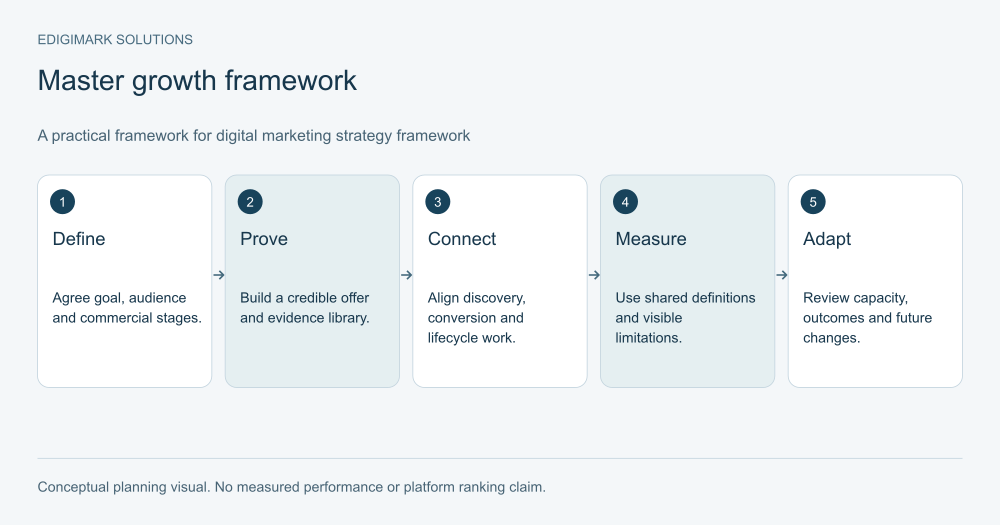

Digital marketing trends 2027 should inform a practical operating plan, not a list of predictions presented as facts. Prepare for mixed search experiences, more automated campaign execution, stronger demands on content quality and closer coordination between acquisition, lifecycle and revenue data. Fund durable foundations and bounded experiments, then update the plan using evidence from your audience.
This outlook uses information available in October 2026. The priorities below are planning recommendations for 2027. They do not claim that future events have already occurred or that a specific platform will deliver a guaranteed commercial outcome.
In this guide
- Digital marketing trends 2027: which changes deserve planning attention?
- How should AI search trends affect the content plan?
- What should paid media planning change?
- Why will content differentiation remain a useful priority?
- How should lifecycle marketing outlook influence investment?
- Which marketing data and attribution foundations are durable?
- Where does AI assistance belong in the annual plan?
- How should the website prepare for several discovery routes?
- What should a practical 2027 allocation model include?
- How should a quarterly roadmap sequence the work?
- How should a marketing trend plan handle uncertain 2027 scenarios?
- How should the annual marketing plan distinguish core work from experiments?
- What should a 2027 planning review produce each quarter?
- How should a marketing trend watchlist remain manageable?
- Frequently asked questions
Digital marketing trends 2027: which changes deserve planning attention?
Prioritize a change when it affects a real buyer task, operating responsibility or investment decision. A fashionable feature with no clear job may deserve monitoring rather than immediate procurement. A current data or conversion problem can deserve funding even when it is not labeled a trend.
Use three categories: established foundations, current capabilities worth testing and uncertain developments worth watching. This prevents the annual plan from treating technical access, a newly available workflow and a speculative prediction as equally certain.
| Priority | Practical 2027 planning response | Evidence to review |
|---|---|---|
| Mixed search discovery | Build accurate resources for investigation and verification | Platform reports, referrals and buyer questions |
| Automated paid execution | Improve conversion definitions and approved assets | Qualified outcomes and actual campaign behavior |
| Content quality | Add distinct decision value and maintain claim evidence | Review findings and commercial use |
| Lifecycle coordination | Connect preference, sales and customer states | Handoff reliability and appropriate progression |
| Revenue measurement | Reconcile CRM, costs and commercial outcomes | Coverage, cohort definitions and uncertainty |
| AI workflow assistance | Pilot bounded tasks with explicit review | Accuracy, failure cases and total effort |
How should AI search trends affect the content plan?
Buyers can encounter generated explanations, conventional results, colleague recommendations and direct supplier pages in the same research journey. The content plan should help them understand and verify the offer wherever they enter.
Google’s current generative-search guidance emphasizes useful resources and technical clarity. Treat that as support for better information, not an invitation to chase a secret citation formula.
Review your important buying pages. Can a visitor understand fit, compatibility, implementation and commercial next steps? Can they distinguish a hypothetical example from a verified result? Does each resource answer a distinct task?
For 2027 marketing planning, prioritize gaps that affect evaluation. A useful implementation guide can support search, sales and partners. Another generic introductory article may add less value even if its keyword sounds fashionable.
What should paid media planning change?
Automation increases the importance of selecting the right outcome and supplying truthful creative. Google’s advertising automation documentation describes bid and creative functions, but the business still owns the offer, conversion meaning and economic constraints.
Review whether campaigns optimize towards meaningful actions. Any submission, a qualified enquiry and a closed deal represent different evidence. Your tracking and feedback process should reflect the purpose of the campaign rather than making every event look interchangeable.
Keep advertisement and destination consistent. If an ad promises a specific assessment, the landing page and follow-up must describe that actual exchange. More automated variations can amplify a misleading promise as easily as a useful one.
Budget for creative and conversion foundations as well as media. A campaign needs accurate resources, dependable forms and available response capacity. Expansion should follow relevant quality evidence rather than raw volume alone.
Why will content differentiation remain a useful priority?
Producing text is easier than producing useful evidence. A content plan should identify the original contribution before drafting: verified experience, a decision model, an implementation worksheet or a well-labeled example that explains a real constraint.
Google’s people-first content guidance provides a useful self-assessment framework. The practical recommendation is to review the actual reader benefit rather than counting pages or treating a production label as quality.
Maintain a claim ledger for important capabilities, numbers and results. Preserve sources and owners so updates can occur when facts change. Do not fill gaps with fabricated case studies or unsupported industry statistics.
Consolidate overlapping intent. Several keywords may represent one decision. A coherent resource can cover those questions without requiring several pages that repeat the same introduction.
How should lifecycle marketing outlook influence investment?
Acquisition should connect to qualification, evaluation, onboarding and customer support. A buyer’s current state matters more than the campaign that first captured them. Existing customers and active opportunities should not receive conflicting acquisition messages.
Write enrollment, exit and suppression rules. Clarify who owns preference state, sales stage and customer status. A connected stack should use authoritative information instead of letting separate campaigns infer incompatible states.
Marketing automation services can support these operating paths. Start by defining the transitions and exceptions before purchasing another sequence builder or AI feature.
Measure reliability and useful progression. An email sequence can execute without helping the buyer. A handoff can create a record without securing a response owner. The report needs to reflect the actual operating task.
Which marketing data and attribution foundations are durable?
Connect enquiries, companies, opportunities and commercial outcomes with clear identifiers. Define the revenue convention and include the full cost scope relevant to the decision. Keep pipeline separate from completed return.
Attribution organizes recorded relationships; it does not observe every influence or prove causation automatically. Preserve unknown coverage, buyer-reported discovery and the model assumptions. A more complex dashboard does not repair an uncertain data foundation.
CRM integration services can maintain associations and commercial stage authority. Data analytics services can support reconciled cohort reporting and a metric dictionary that marketing, sales and finance understand consistently.
For 2027, fund gaps that materially change investment decisions. A dependable lead-to-opportunity join can be more valuable than a new report whose sophisticated chart rests on unreliable records.
Where does AI assistance belong in the annual plan?
Use it for bounded tasks with inspectable outputs: brief review, enquiry summarization, claim inventory or reporting narration. Define authorized inputs, expected output, review and allowed actions. Drafting and external-action authority remain different responsibilities.
HubSpot’s Breeze Assistant guidance ties available actions to permissions. The general operating lesson is to check account access and workflow authority separately from a product’s advertised capability.
Pilot one task and compare useful accuracy with total review effort. Include ambiguous inputs, unsupported claims and failures. Generated volume alone does not establish productivity or commercial value.
AI-powered solutions can help scope this work. Avoid building the annual plan around an untested assumption that every customer interaction should become autonomous.
How should the website prepare for several discovery routes?
Maintain accurate public pages with clear navigation, readable content and dependable commercial actions. A visitor from search, a generated answer, a partner or a direct recommendation should be able to understand the same truthful offer.
Check live metadata and canonical behavior, especially where CMS and frontend are separate. Saved plugin settings need to reach the public page correctly. Verify the actual URL, title, description and visible content rather than assuming the editor represents the final output.
Use web development services when access, rendering or forms need implementation work. Use conversion rate optimization when the exchange, fit or next action is unclear.
Prioritize these repairs according to the business task they support. A small public-page failure can affect several channels at once.
What should a practical 2027 allocation model include?
Separate core operating commitments, foundation improvements and experiments. Core commitments keep useful channels and customer paths functioning. Foundation work repairs shared data, content or conversion gaps. Experiments test uncertain opportunities with a bounded scope.
Do not adopt a universal percentage split. The mix depends on the business, sales cycle, delivery capacity and current evidence. Preserve a rationale for each investment and state what would justify changing it.
Include response and implementation capacity. More acquisition can create work for sales and delivery. If those teams cannot handle useful demand, the next investment may need to repair operations before expanding reach.
Reserve review capacity as well as spending capacity. A test without an owner, evidence source and decision date can consume funds without producing useful learning.
How should a quarterly roadmap sequence the work?
Begin with an inventory of audience, offers, important resources, conversion paths and measurement definitions. Identify the largest gaps affecting qualified evaluation. Repair those shared foundations before launching several unrelated trends-based initiatives.
Next select a small set of channel and workflow hypotheses. A search resource may address a neglected implementation decision. A paid test may examine whether a specific problem resonates. An AI pilot may reduce the effort of a bounded review task.
Assign an owner, dependencies and review evidence. At review, separate execution failures from strategy findings. A broken form does not test demand. Missing source coverage does not justify confidently attributing all revenue to a campaign.
Document the next action and why. The roadmap should improve as the team learns, rather than remain an annual list of fashionable capabilities.
How should a marketing trend plan handle uncertain 2027 scenarios?
Consider three plausible conditions: mixed search behavior continues gradually, generated interfaces become more prominent for your audience, or adoption remains uneven across tasks. Useful buyer resources, technical access, accurate claims and reliable conversions help in all three.
The experiment allocation can change with observed behavior. If relevant AI referrals and buyer-reported discovery increase, investigate the tasks and resources involved. If conventional search and partners remain central, continue supporting those routes. Do not force the evidence into a preferred narrative.
Apply the same discipline to automation. A workflow proving accurate in an internal review task may warrant more use. A customer-facing pilot with unresolved failures may need narrower authority or a return to conventional handling.
This is how a trend becomes a useful planning input: it changes a specific decision under explicit conditions, while the business maintains foundations that remain valuable across scenarios.
Contact Edigimark to build a 2027 plan that connects current capabilities, durable foundations and bounded learning to your actual audience and commercial goals.
How should the annual marketing plan distinguish core work from experiments?
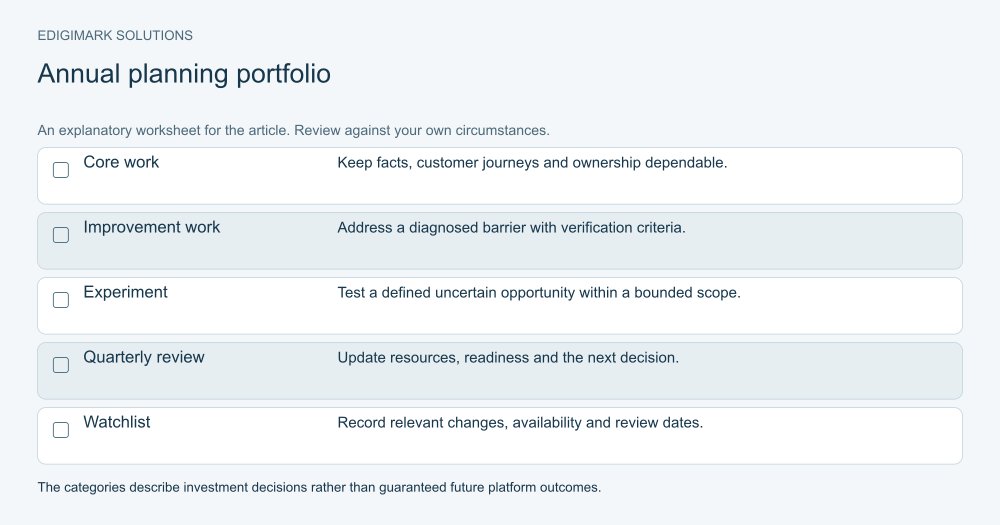
Use a portfolio with three types of commitment. Core work keeps the customer journey usable and the business’s facts current. Improvement work addresses a diagnosed barrier. Experimental work tests an uncertain opportunity with a limited scope. The categories describe the decision being made, not permanent labels for particular channels.
A technical repair can be core work when it prevents enquiry loss. A new generated-search observation process can be an experiment when the business does not yet know whether it will inform a useful decision. Content maintenance can be an improvement when existing evaluation pages omit important conditions. This classification helps the business discuss uncertainty without treating every new feature as a priority.
For each commitment, record the customer task, current evidence, required inputs, accountable owner, resource requirement and review condition. If the team cannot identify the customer task, the activity needs a clearer brief before funding. If it cannot identify an owner, the planned delivery date is not yet credible.
Consider a hypothetical business entering 2027 with incomplete assessment pages and a slow enquiry handoff. Its immediate priorities could be verified service scope, a working request process and reliable assignment. A small AI-assisted brief review might follow once the underlying facts are maintained. A large expansion into several discovery channels would introduce additional work before the business can support it.
This is a sequencing example, not a claim about observed business results. Another organization with reliable foundations could reasonably prioritize distribution or a lifecycle gap. The decision should follow the starting point and capacity rather than the order of a trend list.
What should a 2027 planning review produce each quarter?
Begin with a short evidence inventory: completed work, customer questions, relevant platform observations, commercial progress and unresolved data gaps. Ask which assumptions changed. A new capability may matter less than a change in the offer, audience or sales coverage.
Then review each funded workstream. Is the promised resource available? Are the facts still accurate? Can the team deliver the next action? Does the measurement support the intended decision? A campaign that produces activity but lacks an accountable handoff needs an operational correction before a simple spending increase.
Choose a specific action: continue the current scope, expand it with added capacity, redesign the task, pause it or retire it. Record the reason and evidence level. A short pilot can justify another bounded test without justifying a complete annual commitment.
Update the roadmap, allocation and ownership together. Expanding a content programme may require more expert review; expanding paid distribution may require additional follow-up capacity; adding a new tool may require an integration owner. Recording only the budget change conceals the operating work needed to make it useful.
Finally, carry forward uncertainty honestly. A platform report may describe an appearance or interaction without explaining its full contribution to a purchase. A buyer interview may reveal an important question without establishing how common it is. Keep those limitations visible in the next decision rather than converting all evidence into a confident prediction.
How should a marketing trend watchlist remain manageable?
Maintain a short list of changes relevant to the business’s actual workflows. Record the source, observed availability, affected task, possible response and next review date. Distinguish an announced feature from a capability available in your account and a capability your team has tested.
Assign an owner who can decide whether the change warrants monitoring, a pilot or an implementation task. Avoid maintaining a large catalogue of announcements without a connection to the strategy. A useful watchlist reduces unnecessary reaction while giving the team a clear route to investigate material changes.
Frequently asked questions
Are these digital marketing trends 2027 guaranteed predictions?
No. They are planning priorities based on information available in October 2026. Future product, market and user changes remain uncertain. Review the plan using current evidence.
Should AI search replace the existing SEO budget?
Do not assume that. Assess your audience, useful resources and observed discovery. Technical clarity and accurate content can support several search experiences together.
Which trend should a small business act on first?
Choose the most relevant constraint: unclear offer, weak conversion path, unreliable follow-up or missing measurement. A fashionable tool should not displace a foundation that prevents useful enquiries.
How much budget should experiments receive?
Set a bounded amount suited to risk, capacity and the question being tested. There is no universal percentage. Define the review decision before spending.
How often should the annual plan change?
Review it when material evidence, capabilities or business constraints change. Maintain regular operating reviews, but avoid reacting to every announcement without a task and rationale.
Put the ideas to work
Explore our connected growth services →