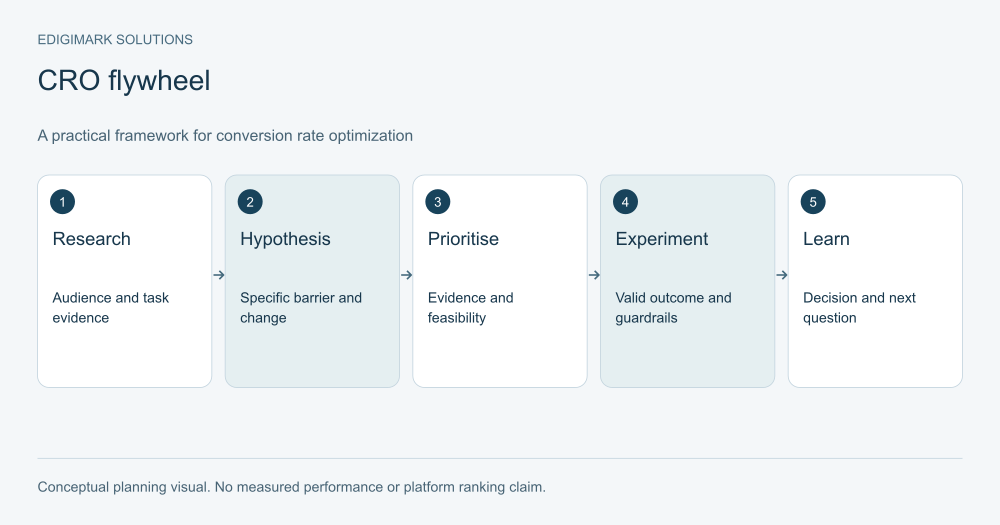
Conversion rate optimization is a disciplined process for helping suitable visitors complete meaningful actions on your website. Research the audience and journey, identify a specific barrier, form a testable hypothesis, improve or experiment on the experience, and measure the commercial effect. A higher button-click or form rate is useful only when it supports the business and the people using the site.
CRO is often reduced to changing colours, shortening forms or copying a competitor’s layout. Those changes can matter in a particular context, but they do not constitute a reliable method. The method begins with the decision the visitor needs to make and the evidence explaining why the current experience does or does not support it.
In this guide
- What should conversion rate optimization improve?
- How should CRO research begin?
- How does conversion rate optimization map the customer journey?
- How do you turn evidence into conversion hypotheses?
- How should conversion rate optimization ideas be prioritised?
- What makes an experimentation process trustworthy?
- Which guardrails belong in a conversion rate optimization experiment?
- How should the experimentation process handle low traffic?
- How should lead-generation CRO differ from ecommerce CRO?
- What role does accessibility play in conversion rate optimization?
- How should conversion measurement be interpreted?
- How do you build a repeatable conversion rate optimization cycle?
- What would a practical conversion rate optimization project look like?
- How should conversion measurement distinguish rate from volume?
- What belongs in the CRO research knowledge library?
- Frequently asked questions
What should conversion rate optimization improve?
Choose a meaningful action and define it precisely. For a retailer, the main outcome may be a completed order, interpreted alongside margin and returns. For a B2B service, it may be a suitable enquiry or qualified meeting. For software, it may be activation rather than account creation alone.
Keep intermediate actions separate. A product view, form start or guide download can help explain the journey, but it should not automatically be treated as the final commercial result.
The basic conversion-rate calculation divides completed actions by the relevant population and multiplies by 100. Specify whether that population is users, sessions, visitors exposed to a page or another defined group. Mixing denominators makes comparisons unreliable.
Optimizely’s CRO overview describes the discipline of generating improvements and testing hypotheses. For a business, the operational question is which outcome the work should improve and which other outcomes must remain acceptable.
How should CRO research begin?
Start with the business, the audience and the task. What does the visitor need to understand? What information is necessary to decide? What risks or limitations matter? What happens after the action?
Collect evidence from several sources. Analytics can show observed paths and drop-offs. Sales and support can reveal repeated questions. User interviews can explain uncertainty. A task-based usability session can show where a person struggles. Technical checks can locate failures.
Each source has limits. A heatmap shows interaction patterns, not the reason behind every action. A small interview sample provides useful insight, not a population estimate. A sales comment needs context before being treated as a universal customer objection.
Combine the evidence into a problem statement. “Visitors cannot tell whether the service supports their integration” is actionable. “The page needs to look more modern” is a preference until it is connected with a user task.
Data analytics helps organise quantitative evidence, while the team’s direct knowledge of customers provides the meaning behind it.
How does conversion rate optimization map the customer journey?
Identify the steps needed for the action: entry page, information review, action initiation, completion, confirmation and operational receipt. Include external booking, payment or account-creation systems where they are part of the task.
Test the journey on relevant devices. A form can work on desktop and fail on a phone. A purchase can succeed until an external payment step. A submission can show a success message while never reaching the intended owner.
Use a funnel report when it helps, but understand its definition. Google Analytics funnel exploration documentation distinguishes open and closed funnels, which affect where users can enter the reported sequence. A reporting choice can change the numbers without changing the website.
Keep real-world paths in mind. Visitors may return, skip a resource or involve a colleague. The map should help locate barriers rather than force every person into one assumed order.
How do you turn evidence into conversion hypotheses?
A useful hypothesis connects a problem, a change and an outcome. For example: because suitable visitors cannot find implementation requirements, placing a clear requirements summary near the demo action may help them assess fit and improve qualified requests.
State the evidence supporting the problem. It might come from interviews, repeated sales questions or task observations. Then state the uncertainty: the proposed change may not be the best solution, or the audience may have other concerns.
Choose a measure that matches the hypothesis. If the goal is qualification, raw form rate alone is inadequate. Include suitability or downstream progression where reliably observable.
Avoid hypotheses that merely assert a favourite design. “Blue buttons convert better” is not a general business rule. A colour change may improve visibility in a particular layout, but the reason and effect need to be evaluated in context.
How should conversion rate optimization ideas be prioritised?
Assess the strength of the problem evidence, commercial relevance, implementation effort and dependencies. Use a simple scoring discussion if it helps, but do not pretend a subjective score is a precise prediction of uplift.
Fix verified failures before testing uncertain preferences. A broken submit button, inaccessible control or misleading offer needs repair. It does not need a prolonged experiment to determine whether making it work is preferable.
Prioritise changes affecting important journeys and suitable audiences. A prominent page with many irrelevant visitors may be less commercially useful than a smaller page serving high-fit prospects.
Record what is ready, what needs evidence and what requires another team. A backlog that ignores development, product or legal review dependencies will overstate what can be delivered.
Our conversion rate optimization service uses this connection between research, priorities and outcomes to make the work reviewable.
What makes an experimentation process trustworthy?
Define the experiment before launch: the population, variations, primary outcome, supporting measures and decision method. Check that assignment, exposure and recording work as intended.
Use a suitable statistical method and sufficient evidence for the question. There is no universal number of days or visitors that makes every experiment reliable. Baseline rate, expected effect, variability and the analysis method influence the requirements.
Avoid repeatedly declaring a winner whenever a favourable number appears. The observation and decision rules should fit the chosen method. If the team uses sequential analysis, it should understand and apply that method properly rather than casually checking a fixed-horizon test every hour.
Microsoft’s trustworthy experimentation guidance distinguishes outcome, guardrail and data-quality measures. That is a useful principle: a result should be judged alongside unintended effects and the reliability of the underlying data.
Which guardrails belong in a conversion rate optimization experiment?
Choose measures for things the business should not materially worsen. Depending on the journey, these may include lead quality, revenue or margin, technical errors, performance, cancellations, accessibility or customer support burden.
A form simplification might increase submissions but remove information required for routing. A checkout change might raise initial orders while increasing confusion and refunds. A new overlay might attract clicks while obstructing another important action.
Define how the team will respond to a serious failure during the experiment. Technical and user-impact monitoring should not wait until the final performance review. Keep a rollback path for material changes.
Guardrails are most useful when they are connected to a decision. Do not add a long list of metrics nobody knows how to interpret. Select the important risks and agree what evidence requires investigation or stopping.
How should the experimentation process handle low traffic?
Use appropriate research and verified improvements rather than running an experiment that cannot answer its question. Observe people completing tasks, interview relevant users, inspect support questions and repair concrete barriers.
You can also make a focused change and observe subsequent behaviour, but report the limitations. A before-and-after comparison can be affected by traffic mix, seasonality, promotions and other changes. It does not isolate causality as cleanly as a properly designed randomised experiment.
Keep the hypothesis and change log. Even when a controlled test is impractical, the team can learn whether the new explanation addresses the problem seen in user research.
Do not use low traffic as a reason to copy unverified “best practices” indefinitely. It changes the evidence strategy; it does not remove the need to understand the audience and task.
How should lead-generation CRO differ from ecommerce CRO?
Lead-generation work must connect the form with qualification and sales handling. A submission can be spam, an unsupported request or a suitable prospect. Define those distinctions and connect outcome data where practical.
Ecommerce work should consider product availability, fulfilment terms, checkout, margin and returns. A higher order rate can still be commercially weak if it comes from deeply discounted products or creates avoidable returns.
Both need a useful experience and reliable measurement. The difference is the commercial chain after the first action. CRM integration supports lead outcomes, while a retail setup may need order and fulfilment data.
Keep the offer accurate. Removing important limitations can create more actions while increasing disappointment. CRO should help suitable customers make informed decisions, not manipulate unsuitable people into a commitment.
What role does accessibility play in conversion rate optimization?
Accessibility helps people complete tasks using different devices and interaction methods. Check keyboard navigation, labels, visible focus, understandable instructions and useful error feedback.
W3C’s form-notification guidance explains the need for clear success and error information. A form that identifies what went wrong and how to correct it supports task completion more effectively than a generic error message.
Treat accessibility as a quality requirement, not only an experiment idea. A test should not compare an accessible experience with an unnecessarily obstructive one merely to count short-term conversions.
Web development can implement the requirements and verify the behaviour. Include representative interaction methods in QA rather than judging the page only by how it looks in a screenshot.
How should conversion measurement be interpreted?
Begin with validity. Confirm that the experiment or observation was implemented and recorded correctly. Check whether the audience and definitions remained appropriate.
Then review the primary outcome, uncertainty and guardrails. A positive point estimate with weak evidence is different from a reliable improvement under the chosen method. A stronger conversion result with poorer qualification may call for revision rather than rollout.
Explain the scope. A result on one page, audience and offer does not prove the same change will work everywhere. Record the context so future teams can judge where the learning applies.
If a result is inconclusive, say so. The experiment can still improve understanding of the problem or reveal implementation issues. Inventing a winner makes the next decision less reliable.
How do you build a repeatable conversion rate optimization cycle?
Keep a shared research record, prioritised backlog, experiment or change brief and result log. Assign owners for page accuracy, implementation, measurement and the commercial decision.
Review findings with the teams handling the outcomes. Sales can explain enquiry quality, support can explain confusion and product can explain capability limits. Their input helps the next hypothesis address a real issue.
Schedule maintenance checks after significant website or integration changes. A previously verified journey can fail when a form, booking tool or checkout dependency changes.
The cycle is research, hypothesis, implementation, measurement and learning. It should gradually improve the usefulness of the site, not become a permanent queue of cosmetic tests.
What would a practical conversion rate optimization project look like?
Consider a hypothetical consultancy whose visitors struggle to understand what a review session includes. User research and sales questions identify uncertainty about scope and preparation.
The team adds a clear session outline, explains the information needed and revises the action label. It verifies the form and routing. Where traffic supports a controlled test, it evaluates qualified requests with appropriate guardrails; otherwise it uses task research and careful observation with limitations stated.
The project’s purpose is to remove a documented decision barrier. This is an illustrative example, not a claim about a client outcome or a guaranteed uplift.
Discuss your conversion research with Edigimark if the site receives relevant visitors but the path to a useful action remains uncertain.
How should conversion measurement distinguish rate from volume?
Rate and volume answer different questions. A page can produce more completed actions because it received more visitors, because the visitors were more suitable, because the experience improved, or because recording changed. Inspect the relevant population and context before crediting one explanation.
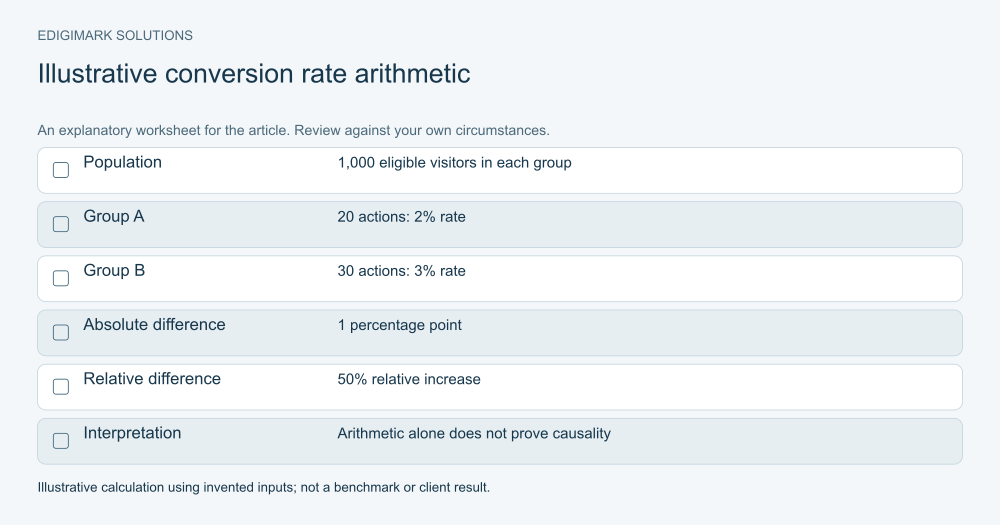
Use an illustrative calculation to keep reporting clear. If 20 of 1,000 eligible visitors complete the defined action, the rate is 2%. If another comparable group records 30 of 1,000, its rate is 3%. That is a difference of one percentage point and a relative increase of 50%. The figures are invented to explain arithmetic, not an experiment result, benchmark or client claim.
Those numbers alone do not establish that a page change caused the difference. The groups need an appropriate comparison, reliable recording and enough evidence under the chosen method. Qualification and other guardrails may also affect the commercial decision.
What belongs in the CRO research knowledge library?
Save the research question, audience, evidence, hypothesis, implementation details and decision. Include failed and inconclusive work as well as positive findings. A library containing only winners encourages the team to repeat ideas without understanding their context.
Keep screenshots or version references where they help identify what visitors actually experienced. Record material offer and traffic changes during the observation period. Link related hypotheses so the next team can see whether an idea builds on previous learning or repeats an unresolved question.
The library should support judgement rather than become a list of universal design rules. A result can suggest where to investigate next; it does not make every page with a similar button or headline an automatic candidate for the same change.
Frequently asked questions
Is CRO the same as redesigning a website?
No. CRO is a research and improvement process that can involve focused changes or, where evidence supports it, broader redesign work. A new visual style alone does not establish improvement. Connect the change with a specific task, hypothesis and outcome.
What is a good conversion rate?
It depends on the audience, offer, action and denominator. A purchase and a guide download are different outcomes. Use consistent definitions, commercial economics and comparable evidence. A generic benchmark cannot tell every business whether its journey is effective.
Does every CRO change need an A/B test?
No. Repair verified failures and use appropriate QA. Controlled experiments help evaluate uncertain choices when traffic and implementation support them. Low-volume sites may need user research and cautious observation instead of an underpowered test.
Can CRO improve results without more traffic?
It can help suitable visitors complete meaningful actions, but outcomes depend on the identified problem and change. Measure quality and commercial effect rather than assuming an uplift. Sometimes the main issue is traffic relevance, which page changes alone cannot solve.
How should CRO success be reported?
Describe the problem, change, evidence, outcome and limitations. Include meaningful commercial measures and important guardrails. Separate completed implementation from proven performance. A result should make the next decision clearer without implying more certainty than the data supports.