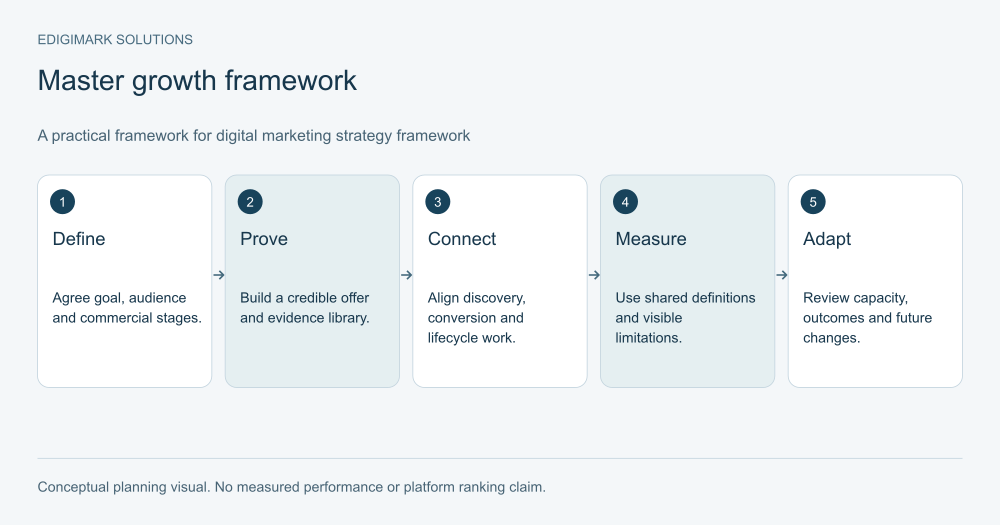
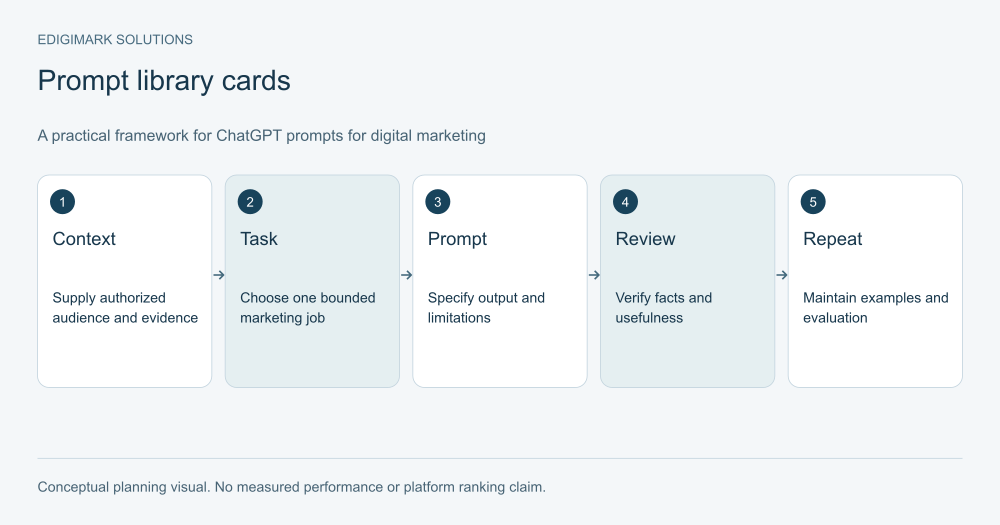
ChatGPT prompts for digital marketing work best when they define the audience, task, evidence and review needed. Use the 50 prompts below as editable starting points for strategy, SEO, ads, CRO, email, social, analytics and operations. Replace every bracketed input with authorized context, then inspect the result before using it in a campaign or external action.
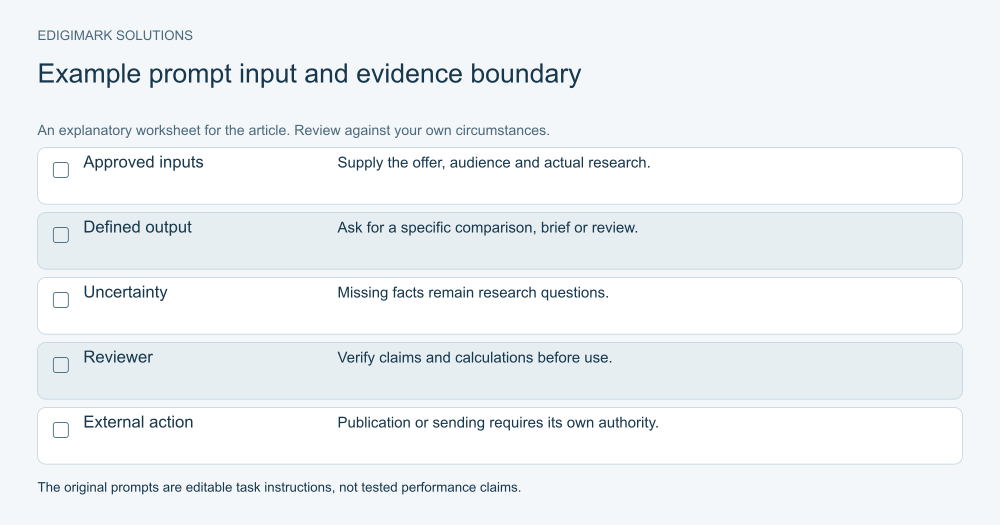
These are original editorial prompts, not tested performance claims. Specific tool access and account capabilities vary. A prompt can ask for analysis, but it cannot manufacture verified facts, customer experience or authority to publish and send.
In this guide
- How should you use these ChatGPT prompts for digital marketing?
- Which strategy prompts help digital marketers?
- Which SEO prompts help digital marketers?
- Which ads prompts help digital marketers?
- Which CRO prompts help digital marketers?
- Which email marketing prompts help digital marketers?
- Which social prompts help digital marketers?
- Which analytics prompts help digital marketers?
- Which operations prompts help digital marketers?
- How should a marketing prompt become a reviewed repeatable workflow?
- Frequently asked questions
How should you use these ChatGPT prompts for digital marketing?
Choose the task you actually need, provide the relevant source material and define the expected output. Keep important limitations visible. If a fact is missing, ask the system to identify the research question instead of filling it confidently.
OpenAI’s prompting guidance is a useful reference for clear tasks and context. Its production prompting documentation also emphasizes evaluation and versioning. The prompts below adapt those general practices to marketing tasks without assuming an API integration.
Use only authorized customer and business data. Remove unnecessary personal details from examples. Review numbers, claims and source support separately from grammar. A fluent answer can still contain an incorrect fact or a recommendation stronger than the evidence.
Which strategy prompts help digital marketers?
1. Define the buying problem
> Using [offer], [audience] and [approved customer research], draft three alternative problem statements. For each, identify the buying trigger, suitable segment, exclusions and evidence still needed. Do not invent interviews or results. Return a comparison table for a strategist to review.
2. Clarify the ideal customer profile
> Review [supplied account examples] and [delivery requirements]. Propose fit criteria, disqualification criteria and ambiguous cases for an ideal customer profile. Distinguish observed evidence from assumptions. Do not infer private budget or purchase intent from a recognizable company name.
3. Assign channel jobs
> Given [audience], [buying journey] and [available resources], propose channel responsibilities for discovery, evaluation and demand capture. State prerequisites, the useful next action and an evidence source for each. Avoid a universal channel ranking or fabricated performance forecast.
4. Find planning assumptions
> Inspect [marketing plan] and list the assumptions on which its recommendations depend. Separate audience, offer, capacity and measurement assumptions. For each, propose a bounded way to test it and identify what evidence would justify changing the plan.
5. Build a commercial objective
> Translate [business goal] and [sales-motion description] into a marketing objective with an observable outcome, responsible owner and review period. Identify dependencies and missing definitions. Do not promise a result or create a target from an unsupported industry benchmark.
Which SEO prompts help digital marketers?
6. Cluster supplied queries
> Group [researched query list] by the underlying reader decision. Identify groups that can share a page, groups requiring distinct resources and ambiguous items. Include the rationale for each decision. Use only supplied metrics and do not invent volume or difficulty.
7. Review page overlap
> Compare [page inventory with summaries] against [proposed topic]. Identify possible intent overlap, a distinct task the new page could serve and consolidation options. Explain the reader benefit of each option rather than recommending another page solely for keyword coverage.
8. Create a source-led brief
> Create a brief for [audience] deciding [task], using [approved facts and sources]. Include the direct answer, necessary sections, useful example and limitations. Mark unsupported claims as research questions. Do not invent firsthand experience or client outcomes.
9. Check an outline
> Review [outline] against [brief and reader task]. Identify repeated ideas, missing decisions and unsupported sections. Propose a revised order with descriptive headings. Explain how each change helps the reader; do not add generic sections merely to increase length.
10. Draft title candidates
> Using [approved article] and [primary topic], propose five accurate page titles. Preserve the actual scope and use numbers only when the article contains the promised items. Avoid guarantees, unsupported superlatives and irrelevant emotional language. Explain any meaningful trade-off.
11. Write truthful descriptions
> Draft three meta descriptions for [page] using [primary phrase] naturally and a target of 140–160 characters. Describe the actual value without a ranking promise. Return character counts for verification and flag any phrase that sounds forced.
12. Inventory factual claims
> Extract claims about numbers, capabilities, policies, prices and outcomes from [draft]. Return the claim, cited source and verification required. Separate advice from platform rules. Mark missing evidence explicitly instead of supplying an invented reference.
13. Suggest contextual links
> Given [draft] and [verified public URL inventory], suggest useful internal links with natural anchor text and a reader-task rationale. Use only provided working destinations. Do not invent blog routes or repeat the same promotional anchor throughout the article.
14. Triage a crawl export
> Inspect [authorized crawl data] for [specified issue]. Return affected rows, observed pattern, possible explanation and next verification step. Keep intended page purpose in view. Do not label a proposed fix confirmed until actual behavior has been checked.
15. Review structured claims
> Compare [visible article facts] with [proposed structured data]. Flag discrepancies in dates, author, organization, image and URL. Identify claims not visible or verified. Return a review list rather than modifying production markup automatically.
Which ads prompts help digital marketers?
16. Clarify the ad offer
> Using [offer], [audience] and [destination], identify the exchange the advertisement can truthfully promise. List fit criteria and delivery prerequisites. Propose a concise message hierarchy, keeping unsupported outcomes and capabilities out of every version.
17. Generate distinct creative angles
> Propose five ad angles for [approved offer], each based on a different relevant buyer concern from [research]. Include the concern, evidence, headline and destination requirement. Avoid fear claims, fabricated urgency and five versions of the same generic benefit.
18. Check ad-page consistency
> Compare [ad copy] with [landing page] and [approved scope]. Flag mismatched promises, missing conditions and inconsistent next actions. Suggest the smallest factual correction needed. Do not strengthen the claim simply to make the advertisement more persuasive.
19. Build a campaign test brief
> Create a test brief for [audience and offer hypothesis]. Specify channel job, destination, conversion definition, qualification criteria, owner and review evidence. Distinguish execution checks from strategy findings. Do not supply an unsupported expected conversion rate.
20. Review negative query themes
> Group [supplied search-query report] into relevant, unsuitable and ambiguous themes using [offer scope]. Explain each proposed exclusion and any risk of blocking suitable intent. Return recommendations for an advertiser to review rather than applying account changes.
21. Evaluate creative coverage
> Review [approved asset set] against [audience questions]. Identify missing explanatory angles, repeated promises and facts requiring approval. Suggest asset concepts that add useful coverage. Do not assume the platform can generate an unavailable format or unsupported capability.
22. Summarize campaign findings
> Using [reconciled campaign table] and [metric definitions], summarize observed changes, quality signals and unanswered questions. Keep arithmetic traceable to the input. Separate correlation from cause and identify whether tracking or delivery should be checked before changing budget.
Which CRO prompts help digital marketers?
23. Review a page decision
> Evaluate [landing page text] for [reader task]. Identify unclear fit, unexplained scope, missing prerequisites and ambiguity in the next action. Prioritize issues by decision relevance. Avoid declaring a conversion lift or inventing user-test evidence.
24. Improve the form exchange
> Review [form fields], [offer] and [follow-up process]. Identify which information is necessary now, what can wait and where the promise is unclear. Consider submission quality and response burden alongside friction. Explain each suggested field change.
25. Write confirmation text
> Draft a confirmation for [specific form action] using [verified response process]. Explain what happened, what comes next and how the person can resolve a mistake. Do not promise timing or a completed assessment unless that behavior is verified.
26. Build test hypotheses
> From [observed page issue and supporting evidence], write three test hypotheses. State the proposed change, reader problem, expected signal and guardrail. Label expectations as hypotheses. Do not invent statistical significance, sample requirements or performance outcomes.
27. Review mobile clarity
> Inspect [supplied mobile screenshots and text] for reading order, unclear controls, missing context and conversion obstacles. Reference visible evidence and identify what requires live testing. Do not claim that a screenshot proves keyboard access or functioning submission.
28. Compare offer versions
> Compare [two offer descriptions] for audience fit, specificity, delivery promise and useful next action. Identify factual discrepancies and questions for the owner. Recommend a clearer version based on the stated task without inventing which one will convert better.
29. Plan qualitative research
> Create an interview guide for [reader decision] using [known uncertainties]. Ask neutral questions about actual experience and evaluation needs. Avoid leading respondents toward the offer. Identify what each question can teach and how findings should remain qualified.
30. Review objection coverage
> Compare [page] with [verified sales objections]. Identify unanswered decisions and propose resources or sections that address them accurately. Keep product limits visible. Do not turn every objection into a stronger promise or invent a case study.
Which email marketing prompts help digital marketers?
31. Match message to exchange
> Compare [draft email] with [signup or enquiry promise] and [current lifecycle state]. Flag a missing resource, unexpected sales request or contradictory timing. Suggest a relevant revision. Keep preferences and sending authority outside the drafting task.
32. Draft an educational sequence
> Outline a sequence for [known audience] learning [problem], using [approved resources]. Give each message a distinct task, useful action and exit condition. Include suppression questions for active sales or customer states. Do not assume every recipient is ready to buy.
33. Create subject options
> Write eight truthful subject-line options for [approved email]. Represent the actual content and preserve important context. Avoid misleading familiarity, false urgency and fabricated benefits. Explain which options suit a direct update versus an educational resource.
34. Review lifecycle transitions
> Inspect [sequence rules] against [authoritative states and preferences]. Identify overlap, missing exits and cases that need human review. Return an exception checklist. Do not infer customer status from incidental page activity or silently change enrollment rules.
35. Prepare a sales reply
> Draft a reply to [authorized enquiry] using [approved scope and resources]. Answer the stated question, identify missing information and describe the verified next step. Preserve uncertainty and avoid inventing availability, budget, prior familiarity or commercial commitments.
36. Repurpose an approved guide
> Adapt [verified guide] into a concise email for [audience task]. Keep capabilities and limitations accurate. Return the draft plus claims omitted or simplified so an editor can check whether the shortened format remains truthful and useful.
Which social prompts help digital marketers?
37. Create useful post concepts
> Propose six social-post concepts from [approved resource], each helping a different reader question. Include the specific lesson and appropriate destination. Avoid invented statistics or claims of personal experience. Identify which ideas need an original visual explanation.
38. Prepare expert discussion questions
> Using [topic and approved evidence], draft questions for an expert discussion that uncover practical constraints and trade-offs. Keep questions neutral and distinguish verified facts from assumptions. Do not script fabricated expert answers or imply the interview already occurred.
39. Adapt a technical explanation
> Rewrite [approved explanation] for [specified nontechnical audience] without changing capabilities or requirements. Preserve the caveat that affects the decision. Return any terms that still need explanation and do not replace useful detail with vague promotional language.
40. Review platform fit
> Compare [approved content idea] with [intended audience and format constraints]. Suggest a suitable presentation and the information required to make it understandable. Flag capability assumptions that need current platform documentation. Do not guarantee reach or engagement.
41. Turn questions into a backlog
> Group [authorized audience questions] by recurring decision and uncertainty. Propose content tasks with a relevance rationale and evidence needs. Do not equate repeated comments with validated search demand or fabricate the size of the audience asking each question.
Which analytics prompts help digital marketers?
42. Define a metric dictionary
> Review [dashboard fields] and [business question]. Propose definitions for enquiries, accepted leads, opportunities, revenue and cost. Identify inconsistent units or periods. Ask for missing ownership decisions rather than choosing an accounting convention without context.
43. Inspect attribution assumptions
> Read [attribution specification] and identify model, window, eligible interactions, unknown coverage and association rules. Explain how each affects interpretation. Separate recorded credit from causal impact and do not assign unmatched revenue to a convenient source.
44. Explain a funnel report
> Using [cohort table] and [stage definitions], describe conversion and elapsed-time patterns. Keep related groups and observation periods aligned. Identify rejection and stall questions. Do not compare unrelated monthly populations or call pipeline completed revenue.
45. Plan a data-quality investigation
> Given [reconciliation mismatch], propose checks for identifiers, duplicates, timestamps, source loss and commercial adjustments. Prioritize reproducible checks and name the required data owner. Do not rewrite records to force agreement or assume the most recent campaign caused the outcome.
46. Draft an executive decision note
> Use [verified findings] to draft a short decision note with the business question, evidence, material uncertainty, proposed action and owner. Keep the recommendation proportional to the evidence. Do not convert an analytical estimate into a guaranteed forecast.
Which operations prompts help digital marketers?
47. Create workflow test cases
> From [approved automation specification], propose tests for normal, duplicate, ambiguous, preference-change and failure scenarios. State expected owner, state and message. Use authorized test data and distinguish planned cases from tests that actually ran.
48. Review a handoff agreement
> Inspect [marketing-to-sales agreement] for qualification evidence, owner, response expectation, rejection feedback and escalation. Identify missing responsibilities. Suggest specific wording without promising a capacity or service level the team has not approved.
49. Build an AI workflow boundary
> For [proposed use case], specify authorized input, expected output, allowed action, reviewer, failure path and evaluation examples. Separate drafting from external-action authority. Identify uncertainty that must route to review instead of being resolved through invention.
50. Summarize completed changes
> Turn [approved implementation record and test evidence] into a change summary with effective date, owner, behavior and limitations. Preserve the difference between completed, planned and unverified work. Do not describe a proposed configuration change as already deployed.
How should a marketing prompt become a reviewed repeatable workflow?
Keep the prompt, example inputs, expected output and review criteria together. Record failures and changes. A repeated task deserves evaluation cases covering missing context, ambiguous records and unsupported claims, not just one successful example.
For SEO prompts and content tasks, digital marketing services can connect the output with an actual audience and editorial plan. For CRO prompts, conversion rate optimization supports page and offer decisions. Data analytics helps preserve dependable metric definitions.
When outputs connect to operational systems, marketing automation and CRM integration support authoritative lifecycle states and accountable handoffs. AI-powered solutions can help define the task boundary and evaluation.
Contact Edigimark to select a recurring marketing task and build a prompt workflow that improves useful accuracy and review effort.
Frequently asked questions
Can I copy these prompts without changing them?
Replace the bracketed context first. A prompt without the audience, facts and actual task can produce generic or unsupported output. Adapt the scope and review to your business.
Do prompts guarantee good marketing results?
No. They organize a task and its constraints. Results depend on evidence, product and audience fit, execution, review and many other factors beyond the wording of a prompt.
Which ad copy prompts should a beginner use?
Start with clarifying the offer and checking ad-page consistency before generating variants. Accurate scope and an appropriate destination provide a stronger foundation than many persuasive headlines.
Can I use confidential client data in a prompt?
Use only information you are authorized to provide to the selected tool under the relevant account controls and agreements. Remove unnecessary sensitive details and verify the actual data-handling configuration.
How should I check a generated answer?
Verify factual claims and calculations against sources, inspect usefulness for the reader’s task and confirm any real implementation separately. Drafting an action does not prove it occurred or authorize it.