B2B lead generation strategies work best when each channel has a defined funnel job, a relevant audience and a useful offer. Combine discovery, evaluation support and demand capture instead of expecting one tactic to create every stage of a buying journey. Prioritize according to the current constraint, then review sales acceptance and commercial progression alongside cost and volume.
There is no universal ranking of channels that “actually work” for every business. A technically complex service, a self-service product and an enterprise platform face different buying decisions. The strategy portfolio should reflect those differences and the capacity available to respond.
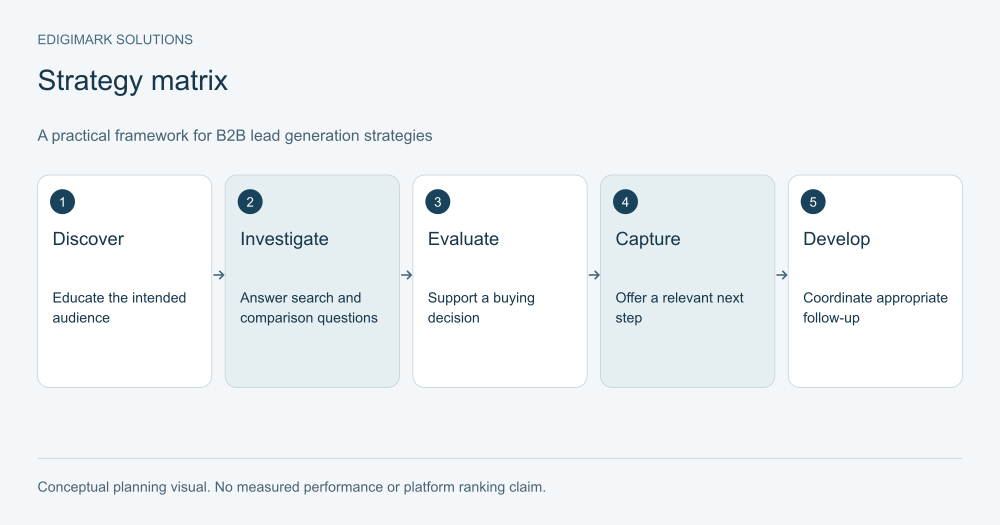
An editorial planning diagram; stages and examples are illustrative.
How do you prioritize B2B acquisition channels?
Begin with the intended customer, buying problem, current evidence and commercial next action. Ask where suitable buyers investigate, which questions delay evaluation and what your team can credibly deliver. A channel is a method for reaching that situation, not the strategy by itself.
Assess prerequisites. Search needs useful discoverable resources. Paid acquisition needs an offer and destination. Partners need shared relevance and a reliable referral process. Outbound needs appropriate contact context and communication handling. Events need expertise and a worthwhile participant experience.
Write the intended job in one sentence before assigning a budget. “Help operations leaders assess a supported integration problem” is clearer than “generate more leads.” This makes both the asset and its reporting more specific.
Edigimark’s digital marketing services can coordinate this portfolio around a common audience and commercial objective.
Which strategies fit each funnel stage?
| Funnel job | Suitable strategy examples | Necessary foundation |
|---|---|---|
| Problem discovery | Expert resources, relevant professional participation, educational distribution | Clear audience problem and accurate explanation |
| Active investigation | Search-visible use-case, comparison and implementation pages | Distinct buying questions and technical access |
| Evaluation support | Workshops, technical walkthroughs and shareable decision resources | Relevant expertise and transparent scope |
| Demand capture | Assessment, trial or consultation offers | Working destination, qualification and response owner |
| Relationship development | Appropriate lifecycle communication and partner follow-up | Preferences, useful content and coherent state |
An activity can serve several jobs. Identify its primary job so the immediate outcome is evaluated honestly, then inspect how it connects to downstream commercial activity.
When is inbound lead generation through search useful?
Search is useful when the audience expresses its problem or evaluation questions in discoverable queries. Prioritize pages that explain fit, supported requirements, trade-offs and next steps. Generic introductory content alone may attract a broad audience without providing a commercial route.
Google’s Search Essentials define the baseline for eligibility and useful content. Your lead strategy still requires a relevant offer and dependable follow-up; being searchable does not establish that a visitor has buying readiness.
Develop resources around distinct tasks. A supported-integration page, a migration-planning guide and an implementation-assessment page can serve different decisions. Several articles with minor keyword variations and the same advice can confuse both readers and editorial priorities.
Measure qualified evaluation as well as visits. Inspect which resources lead to useful questions and accepted enquiries. Keep time lag and incomplete attribution visible when reviewing commercial contribution.
When should paid search receive priority?
Consider paid search when relevant demand is expressed through queries, your offer addresses it and you have a reliable destination. It can test a use case or commercial proposition without waiting for organic visibility to develop, but the test needs clear scope and measurement.
Separate high-intent commercial searches from early educational searches. They may need different offers and review criteria. An informational visitor may value a diagnostic, while a person seeking implementation support may want a scoped conversation.
Before launch, define qualification, source recording and the receiving owner. Campaign data is less useful when every conversion is treated as equivalent or commercial outcomes never return to the review process.
Review the full cost: media, management, creative, landing-page work and follow-up. A low cost per submission can conceal weak fit or an expensive qualification burden.
How can paid audience distribution support B2B leads?
Use it to test a relevant problem explanation, promote a useful resource or support selected buying groups. The audience may not be actively searching, so the first useful action can differ from a direct consultation request.
Be specific about the hypothesis. A hypothetical workflow consultancy might test whether a concise diagnostic resonates with operations managers in a supported segment. It then reviews relevant engagement and the quality of ensuing assessment requests, rather than judging success only through impressions.
Keep the destination aligned with the message. Avoid an educational advertisement that lands on an unrelated sales form. Provide enough information for the visitor to understand the problem and choose an appropriate next step.
Conversion rate optimization services can help examine the offer, page and resulting enquiry quality before broader distribution is funded.
What makes partner lead generation worth investing in?
Partners are useful when their work connects naturally with your offer and they understand which prospects you can serve. A relevant introduction can contain context that a broad campaign lacks, but that relevance must be designed rather than assumed.
Write referral criteria, responsibilities and any commercial arrangement. Explain which information is shared, how the prospect expects contact and who owns follow-up. Keep feedback useful without disclosing inappropriate details.
Salesforce’s referral-partner guide describes partners as contributors to the introduction process. For your program, assess actual fit and operating effort instead of assuming referrals automatically have lower acquisition cost.
Start with a joint educational resource or a clear introduction path. Review the questions and outcomes before expanding. A partner relationship can create a durable source of relevant context, but it also requires maintenance and shared trust.
How should workshops and webinars generate enquiries?
Choose a topic that resolves a specific decision. A broad trend presentation may attract general interest; a practical workshop on implementation requirements may attract a more defined audience. Both can be useful if the intended job is clear.
State what participants receive and how follow-up works. Deliver the promised session or resource. Offer an optional assessment or discussion when appropriate without treating every attendee as a ready buyer.
Capture questions as editorial and sales-support evidence. Repeated uncertainty about migration, compatibility or commercial scope can identify a useful next resource. Keep attendance and requests for follow-up distinct in the report.
Co-hosted events need agreed record handling and communication responsibilities. Duplicate messages from several teams can weaken an otherwise useful experience.
Where does researched outbound fit?
Outbound can support a relevant conversation when the contact context, message and communication process are appropriate. It should be grounded in a credible fit hypothesis, not a claim that public information reveals private purchase intent.
Explain the reason for contacting the business and offer something useful. Do not invent prior familiarity or misrepresent a referral. Respect declines and maintain preference handling across future campaigns.
For email, review provider and recipient-system requirements. Google’s sender guidelines describe authentication and unsubscribe requirements for applicable messages. Delivery compliance is part of operating the channel, alongside relevance and the rules governing your actual audience.
Measure meaningful responses and commercial fit instead of sending volume. A campaign that creates many replies from unsuitable businesses has not necessarily advanced the acquisition objective.
How does lifecycle communication improve the portfolio?
Lifecycle communication helps known prospects continue a relevant decision. A researcher can receive a useful explanation, an evaluator can receive implementation resources and a customer can receive adoption support. These paths need enrollment, exit and suppression rules.
Avoid independent sequences that compete for the same person’s attention. An active sales discussion should change communication priorities. Existing customers and support requests also need appropriate handling.
Use marketing automation services when the portfolio requires shared state and reliable coordination. Automation should preserve the meaning of the original action and avoid turning every interaction into the same sales sequence.
Inspect buyer responses and stage outcomes. Activity can provide context, but it does not prove authority or readiness. Keep suitability, intention and behavior visible as separate inputs to qualification.
What should a B2B channel prioritization scorecard contain?
Score each proposed strategy against audience evidence, offer readiness, destination quality, sales capacity, data reliability and expected learning. Explain the score rather than presenting an unexplained total as objective truth.
An audience score asks whether suitable buyers actually use the channel for the relevant task. An offer score asks whether the exchange helps them. A capacity score asks whether your team can respond. A measurement score asks whether the result can inform the next investment decision.
Include effort and dependencies. A channel may be promising but require a technical page, approved resource or partner agreement before testing. Resolve the dependency instead of labeling the channel ineffective after a premature launch.
Use a small portfolio of complementary jobs. One demand-capture channel and one educational or partner channel can be more manageable than many campaigns sharing an unclear purpose.
How do you connect strategy results to sales outcomes?
Preserve the original request, source, campaign context where available and qualification decision. Associate contacts with companies and opportunities appropriately. Define who owns commercial stages and how rejected leads return useful feedback.
CRM integration services can maintain these relationships. A synchronized record is useful only when the receiving person can understand the buyer’s request and the report can interpret its progression.
Use cohorts and a consistent observation period. Do not compare this month’s new contacts with unrelated deals that close this month. Report known source coverage and buyer-reported discovery separately where appropriate.
Data analytics services can combine activity, qualification and commercial evidence. Attribution remains a view of recorded relationships; it should not be described as complete proof of incremental impact.
What should the first portfolio review decide?
Start with execution. Did the page work, the form route correctly and the promised response occur? A delivery failure needs repair before a strategy conclusion is drawn.
Then inspect audience and offer quality. Did the intended segment engage? Were requests suitable? Which recurring questions prevented evaluation? Which channels produced useful context rather than only contact volume?
Finally decide the next action: improve an explanation, narrow an audience, repair a handoff, create an implementation resource or expand a demonstrated learning path. Record the hypothesis and review date. Do not change every channel simultaneously when the goal is to understand the constraint.
A useful strategy portfolio is an operating system for reaching and helping suitable buyers. Contact Edigimark to assign channel roles and prioritize the first acquisition investment your team can support well.
How do you use a strategy matrix without creating false certainty?
Treat the matrix as an organized judgement rather than a universal channel ranking. Score audience evidence, offer readiness, delivery dependencies, response capacity and measurement usefulness. Record the explanation behind each score so another team member can challenge it productively.
For a hypothetical B2B consultancy, search might score well for explicit integration questions but depend on a missing compatibility resource. A partner workshop might score well for relevant context but depend on an agreed follow-up process. Paid distribution might be feasible immediately, yet have weaker audience evidence. These are different planning conditions, not fixed labels of good and bad channels.
Which prerequisite should be repaired first?
Choose the one blocking a commercially important buying task. An accurate assessment page can support search, partners and paid acquisition. A reliable sales handoff can improve all captured enquiries. Such shared foundations may deserve priority before adding another independent source.
Record the expected benefit and the evidence that would confirm it. “Clarify the supported systems so fewer incompatible assessment requests occur” is more testable than “improve the website.” Keep the review tied to the original constraint.
How do you compare strategy effort fairly?
Include media, production, management, relationship work, qualification and follow-up. Reusable resources can support several channels, so allocate their cost with a stated convention. Do not count them as free in every report or charge the full cost repeatedly.
Review commercial progression over a period that fits the buying journey. A workshop attendee may investigate later, while an explicit search enquiry may be closer to action. Immediate conversion and later contribution need separate views.
What should happen after a portfolio review?
Select a small number of accountable changes. Improve the audience, offer, resource, destination, handoff or measurement gap identified by the evidence. Keep the other parts stable when possible so the next review can assess whether the change helped.
If the result remains uncertain, write the uncertainty and the next learning question. A portfolio does not need every channel to be labeled successful after one cycle. It needs disciplined decisions about where more evidence is worthwhile and where operating capacity is better used elsewhere.
Frequently asked questions
What is the best B2B lead generation channel?
It depends on audience behavior, the buying problem, the offer and your operating capacity. Choose a channel with a clear job and inspect qualified outcomes rather than adopting a universal ranking.
How many strategies should a small team run?
Begin with a manageable set that covers distinct jobs. Each needs an owner, useful destination and review process. Add channels when the existing system works and the next channel addresses a clear gap.
Are inbound leads always better than outbound leads?
No. The source does not guarantee fit or readiness. Compare actual request context, qualification, effort and commercial progression for your business.
Should every strategy lead directly to a demo?
No. Match the action to the buyer’s task. Early education can lead to further research; active evaluation can lead to an assessment or demonstration. Keep a clear commercial route available for people ready to act.
What if a strategy creates attention but no accepted enquiries?
Check whether its intended job was education or capture, then inspect audience fit, the offer, destination and follow-up. Use the evidence to identify a specific gap before increasing spend or abandoning the channel.
Put the ideas to work
Explore our connected growth services →