A B2B email nurture campaign should help an eligible contact resolve a relevant decision through a small sequence of useful messages. Begin with the interest they expressed, give each email a distinct purpose, and define the conditions for a human response or an exit. Sending every planned email is not the objective; helping the person take an appropriate next step is.
The six-email example below is an original planning model for a hypothetical CRM implementation business. It is not a published customer campaign or a performance benchmark. Adapt its content, timing and eligibility to your offer and audience before using it.

In this guide
- What should be defined before writing a B2B nurture sequence?
- Which email lifecycle stages should the campaign support?
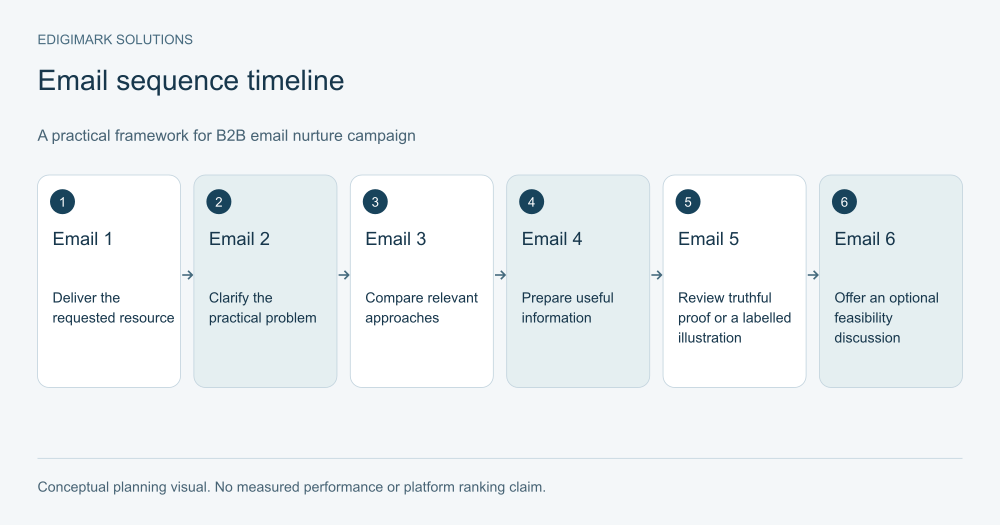
- What is an illustrative six-email campaign timeline?
- Email 1: How should the campaign fulfil the original request?
- Email 2: How should lead nurture content clarify the problem?
- Email 3: How should the campaign help compare approaches?
- Email 4: How should the sequence prepare a useful conversation?
- Email 5: How should the campaign present proof responsibly?
- Email 6: What should the final nurture invitation ask?
- Which email handoff criteria should override the sequence?
- How should B2B nurture suppression and exits be designed?
- What should be checked for email delivery and usability?
- How should a B2B email nurture campaign be measured?
- How should a B2B nurture campaign be tested and improved?
- Frequently asked questions
What should be defined before writing a B2B nurture sequence?
Identify who enters, why they enter and what question the sequence helps them answer. A person requesting an implementation guide has expressed a different need from someone requesting a sales discussion.
Write the intended progression in plain language. In this example, the contact moves from understanding migration preparation to comparing approaches, gathering evidence and deciding whether a feasibility conversation would help.
Define communication eligibility and exclusions. Current customers, active opportunities and contacts already speaking to a relevant owner may need a different path. Appropriate preferences are part of the design, not a final launch checkbox.
Marketing automation should connect those decisions with the actual records and triggers. The writer needs to understand what the system knows and what it cannot reliably infer before personalising a message.
Which email lifecycle stages should the campaign support?
Use stages to organise the person’s decision, not to claim a fixed buying journey. A useful campaign may support problem clarity, options, preparation, evidence and a relevant discussion.
Keep message progression separate from qualification. A contact who receives the last email has not necessarily become an SQL. A reply naming a concrete requirement can warrant review much earlier.
Select content that makes each stage useful. Repeating a meeting invitation six times is not a nurture sequence merely because the messages have different subject lines.
The featured timeline should display six distinct content purposes. It should not depict every contact as becoming a customer at the end or imply that the proposed timing is a tested best practice.
What is an illustrative six-email campaign timeline?
The following schedule is a starting hypothesis for eligible contacts who requested a migration planning resource. It assumes that no reply, meeting, preference change or other relevant exit occurs. Those conditions should override the timetable.
| Illustrative send point | Decision supported | |
|---|---|---|
| 1 | After the request is completed | Receive the promised resource and orientation |
| 2 | Around day 3 | Identify the practical migration problem |
| 3 | Around day 7 | Compare implementation approaches |
| 4 | Around day 11 | Prepare data and ownership information |
| 5 | Around day 16 | Review relevant proof or a clearly labelled example |
| 6 | Around day 21 | Decide whether a feasibility discussion would help |
The intervals are invented planning inputs, not a recommended universal cadence. Review the combined communication programme, audience expectations and available evidence before choosing timing. An explicit request for help should receive an appropriate direct response rather than wait for the next scheduled email.
Email 1: How should the campaign fulfil the original request?
Purpose: deliver what the person asked for and explain its practical use. A suitable subject might be “Your CRM migration planning checklist,” provided that is the resource actually requested.
The opening should acknowledge the request accurately. “Here is the checklist you requested” is clear. “I personally reviewed your migration project” would be inaccurate if no review occurred.
An original illustrative body could read:
> Use the checklist to identify your current systems, the data you need to retain and the people responsible for decisions. You do not need a complete migration plan before starting; the first step is to make the unknowns visible.
The main action is access to the promised checklist. Add a monitored reply route for a question if the team can support it. Do not bury the resource beneath several competing sales buttons.
Verify the public destination, file or page access, and the reply inbox. Store the original request context so subsequent messages remain relevant. A fulfilment message that delivers the wrong asset damages the sequence before any nurture begins.
Email 2: How should lead nurture content clarify the problem?
Purpose: help the contact describe the actual obstacle. A suitable subject might be “Which CRM migration constraint needs attention first?”
Use practical distinctions: inconsistent data, unclear ownership, missing integration requirements or uncertainty about the future process. These are prompts for self-assessment, not diagnoses of the recipient’s business.
An original illustrative body could read:
> Before choosing a migration approach, identify the problem you need it to solve. Is the current difficulty unreliable data, duplicated work or a process that no longer fits? Different problems need different preparation, even when the software decision looks similar.
The action could be a short worksheet that helps record the constraint. A voluntary reply naming the main question may be useful if an owner is prepared to respond.
Do not claim the system knows the person’s problem because they downloaded a guide. Keep the message conditional and invite clarification. If the contact replies with a specific need, route it for review and pause the generic path as appropriate rather than sending the next email unchanged.
Email 3: How should the campaign help compare approaches?
Purpose: provide a useful comparison without pretending one approach fits every business. A suitable subject might be “Compare migration approaches before choosing a route.”
Explain decision factors such as complexity, internal capacity, integration needs and risk of disruption. Use a comparison that reflects the business’s genuine service scope and available evidence.
An original illustrative body could read:
> A staged migration can make sense when teams or data groups need separate preparation. A broader cutover may suit a different operating context. Compare the dependencies, ownership and verification needed for each route before choosing based only on the visible schedule.
The main action is a relevant comparison resource. Keep any implementation claims supported and current. If the business cannot provide a certain approach, say so in the resource rather than presenting it as an available service.
Avoid an unqualified claim that one option is fastest, safest or cheapest. The email should make the next assessment clearer. A contact asking which route fits their situation may need human clarification because the campaign cannot inspect their actual systems.
Email 4: How should the sequence prepare a useful conversation?
Purpose: help the person gather the information that would make a feasibility discussion productive. A suitable subject might be “Prepare the information a migration review needs.”
List a small set of useful inputs: systems involved, important data types, known integrations, responsible stakeholders and major constraints. Explain why the information matters.
An original illustrative body could read:
> You can make an initial migration discussion more useful by listing the source systems, the information that must remain connected and the person responsible for each decision. Unknowns are acceptable; label them so they can be clarified rather than guessed.
The action could be completing a preparation sheet for internal use. It should not require the person to send sensitive databases or credentials through an ordinary marketing reply.
Make the request proportionate to the stage. A contact exploring options may not have a complete technical inventory. The campaign should lower uncertainty without turning educational nurture into a demanding pre-sales homework assignment.
Email 5: How should the campaign present proof responsibly?
Purpose: help the contact judge relevant experience or a method. A suitable subject might be “What a practical migration plan needs to show.”
Use a real, approved example when available and describe its context. If no appropriate case study exists, provide an explicitly labelled conceptual example. Do not fabricate a client, testimonial or outcome to complete the sequence.
An original illustrative body could read:
> A useful migration plan makes identity matching, field ownership and verification visible. In our conceptual worksheet, each field has a meaning, an owner and a test condition. The worksheet illustrates a planning method; it does not report a customer implementation result.
The main action could be viewing that worksheet or a verified relevant case study. The destination should contain enough detail to support the email’s description and acknowledge limits.
Avoid moving directly from an impressive number to a universal promise. The recipient needs to understand whether the context resembles their own situation. Digital marketing should work with delivery teams to keep proof accurate and useful.
Email 6: What should the final nurture invitation ask?
Purpose: offer a clear, optional next step when a conversation may help. A suitable subject might be “Would a migration feasibility discussion be useful?”
Explain who the discussion is for and what it covers. Name the preparation needed and what the person can reasonably expect afterward. Do not imply an assessment or proposal is already complete.
An original illustrative body could read:
> If you are evaluating a migration and want to clarify the dependencies, a feasibility discussion may help. We can review your stated systems and known constraints, identify questions that need investigation and agree whether a further assessment is appropriate.
The action is a clear request or scheduling route that works on the public site. The responsible team needs the campaign context and the person’s submitted needs.
Provide a respectful conclusion for people who do not take that step. Completing the sequence should not automatically restart it or trigger an increasingly urgent sales message. A useful campaign leaves the person informed, with an accessible route if their situation changes.
Which email handoff criteria should override the sequence?
Define a human review route for explicit replies, relevant meeting requests and questions needing judgement. A named need or constraint is often more useful than a raw interaction count.
Distinguish a scheduling link click from a confirmed booking. Verify the actual event reaching the system. The handoff should rely on the intended outcome rather than a convenient proxy that can misclassify people.
Give the receiving person the original request, content context and latest question. CRM integration should make that record accessible without forcing sales to reconstruct the sequence from a campaign name.
Agree acknowledgement, ownership and escalation. The campaign’s responsibility does not end merely because a notification was sent. Confirm who accepts the request and what happens if the owner is unavailable.
How should B2B nurture suppression and exits be designed?
Write exit conditions before building message delays. Changed preferences, confirmed mismatch, active related conversations and customer status can alter eligibility depending on the message purpose.
Review the person’s combined communication experience. A six-email campaign can overlap with newsletters, event invitations and sales activity. Decide which communication takes priority and how the team sees conflicts.
Test changes that occur while a contact is waiting. The next message should still be appropriate at execution, not merely at enrolment. Verify your platform’s supported behaviour and implement the intended rule.
Keep exits inspectable. An intentional suppression should not be counted as a delivery failure, and a stopped generic sequence should not erase the relationship history or the person’s original request.
What should be checked for email delivery and usability?
Review sender identity, authentication, unsubscribe support and sending practices against the actual provider requirements. Google’s email sender guidelines distinguish requirements for senders to personal Gmail accounts, with additional conditions for bulk sending. Verify the applicable details with the technical owner.
Test the email on relevant devices and clients. Check readable text, meaningful links, image alternatives and a coherent experience when images do not load. The message should still communicate its purpose.
Verify every destination and form. Web development can help ensure the email’s promised next action remains available on the public site.
Monitor reply handling as part of delivery quality. A technically delivered message is not a successful customer experience if a useful reply has no accountable reader.
How should a B2B email nurture campaign be measured?
Define operational and decision outcomes separately. Operational measures include delivery issues, broken destinations, missing ownership and suppression. Decision outcomes include useful replies, accepted discussions and later qualification where the records support that view.
Treat open rates cautiously. Apple’s Mail Privacy Protection explanation describes background downloading of remote content regardless of engagement. An apparent open is therefore not a reliable confirmation that a person read or understood the message.
Review eligible cohorts and the observation period. A campaign reaching different audiences or using stricter entry criteria cannot be compared fairly through one rate alone.
Data analytics can connect engagement and sales feedback with clear definitions. Do not assign every later sale to the sequence because the person received one email.
How should a B2B nurture campaign be tested and improved?
Use authorised records representing eligibility, repeated entry, reply, changed preference, booking and existing relationship. Check the message, destination, record changes and receiving-team task for each case.
Begin with a controlled launch and review useful feedback. A confusing resource or inaccurate promise deserves repair even when an engagement metric looks encouraging.
Change one consequential decision at a time when possible, with a clear question. Compare evidence appropriate to the audience and traffic, and label uncertain results. Avoid universal conclusions from a small set of responses.
Ask Edigimark to build a useful B2B nurture sequence when the campaign calendar is full but each message’s purpose, exit or handoff remains unclear.
Before launch, ask a delivery-team reviewer to check the message claims and a receiving-team reviewer to test the handoff. They should confirm that the stated discussion, resource and next step match what the business can provide. This catches inaccurate promises that a link test or spellcheck cannot identify.
Frequently asked questions
How many emails should a B2B nurture campaign contain?
Use enough messages to support distinct useful decisions. This article provides six as a planning example. The right number depends on audience, content, relevance and exits, rather than a universal benchmark.
Is the sample three-week timeline a best practice?
No. Its intervals are illustrative hypotheses. Choose timing from the person’s context and the combined communication programme, then review actual evidence and feedback.
Should a sales-ready reply wait for the sequence to finish?
No. Route an explicit relevant request to an accountable person. Pause or alter competing generic nurture while the conversation is handled.
Can a concept worksheet replace a case study?
It can explain a method when clearly labelled. It should not pretend to be customer proof or report invented performance results. Use genuine approved cases when they are available and relevant.
Which measure matters more than open rate?
Look at useful replies, accepted handoffs and relevant progression, with operational reliability and clear definitions. Open tracking has limitations and does not establish comprehension or buying readiness.