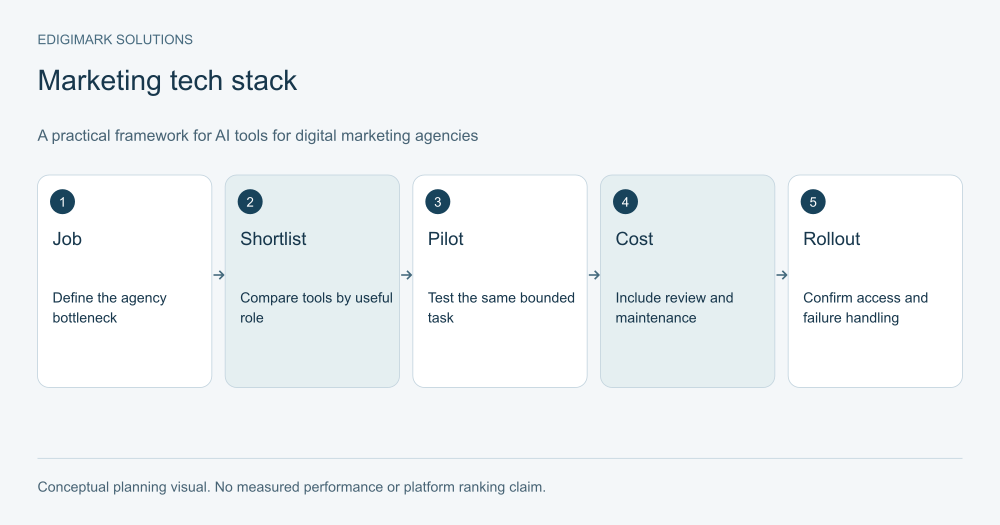
AI tools for digital marketing agencies should be compared by the job they perform, the data they require and the review effort they create. Start with your existing workflow, then shortlist tools for research assistance, content production, design, CRM work and automation. The best fit is the tool your team can use accurately and maintain, not the product with the longest feature list.
This shortlist was researched in October 2026. It is an editorial comparison of documented capabilities, not a hands-on benchmark or a claim that one product is universally best. Product names, availability, plans and usage limits can change; verify the current account conditions before buying.
In this guide
- How should you shortlist AI tools for digital marketing agencies?
- When should an agency evaluate ChatGPT for research and content?
- When does Claude Projects deserve consideration?
- When is HubSpot Breeze Assistant relevant?
- How should an agency evaluate Canva’s AI content tools?
- What should you check in Zapier’s AI automation products?
- Why should advertising automation be compared separately?
- How do you compare AI research tools fairly?
- What costs should the AI tool budget include?
- What should an agency’s tool-selection worksheet contain?
- How should an agency roll out the selected tool?
- What should a comparable AI agency pilot task test?
- How should AI agency workflow tools be matched to specific jobs?
- What should an agency record after selecting an AI tool?
- Frequently asked questions
How should you shortlist AI tools for digital marketing agencies?
| Tool or product family | Job to evaluate | Important question before purchase |
|---|---|---|
| ChatGPT | Context-led research organization, briefs and draft review | Does the account provide the tools and controls your task needs? |
| Claude Projects | Work with a maintained context and knowledge collection | Can the agency organize client context and review access appropriately? |
| HubSpot Breeze Assistant | Assistance within CRM-related work | Which actions and data are available under account permissions? |
| Canva AI tools | Design and adaptation within a visual workflow | Is the required feature actually available, with usable editing and export? |
| Zapier AI workflow products | Connect bounded AI tasks with applications | What is the current product path, action authority and failure handling? |
| Google Ads automation | Bid and creative functions inside advertising | Are conversion definitions, assets and business constraints dependable? |
These tools overlap in some tasks. A shortlist does not imply that an agency needs every product. Use a shared test brief to decide which fills an actual gap.
When should an agency evaluate ChatGPT for research and content?
Consider it for organizing approved material, generating brief options and reviewing an outline against a reader’s task. Provide authorized facts, audience context and output requirements. Important claims still require verification.
OpenAI’s prompting guidance supports clear tasks and context. The practical evaluation is whether your team can produce useful drafts with manageable factual and editorial review. Do not assume any particular browsing, file or connected-application capability without checking the account.
Test a real bounded job. Supply an approved service description and buyer questions, then ask for a brief with unsupported facts marked as research questions. Inspect original contribution, omissions and invented detail. A tool that generates attractive prose but repeatedly expands the claim beyond the source may need tighter scope.
Keep client data and task authority separate. Draft assistance does not require permission to publish, send messages or modify the CRM. Grant only the access needed for the actual operation.
When does Claude Projects deserve consideration?
Claude’s Projects documentation describes workspaces with project knowledge and instructions. This can be relevant when an agency needs consistent context for repeated work.
The evaluation should focus on context accuracy, access and maintenance. A collection of outdated product descriptions can produce consistently wrong outputs. Assign an owner to the material, distinguish approved facts from drafts and review the actual availability and limits of the selected account.
Use the same bounded task as other research or content tools. Compare claim accuracy, reference traceability, useful structure and review effort. Do not declare a winner based only on one impressive answer or an unrelated model benchmark.
If the agency serves several clients, define how their contexts are separated and who can access them. A convenient workspace design must still match the agency’s actual permissions and agreements.
When is HubSpot Breeze Assistant relevant?
It is most relevant to evaluate when the agency or client already operates within HubSpot and needs assistance with content, record summaries or account work. HubSpot’s Breeze Assistant documentation notes that user permissions determine available actions and that AI access and data sharing are configurable.
Test the workflow using authorized records. Check whether summaries preserve the original request and whether uncertain information is labeled. Confirm that the receiving owner can inspect the underlying source rather than relying on a generated account narrative.
Evaluate the plan and feature conditions for the actual job. A product family being available does not establish that every connected task is included or configured. Budget for setup, permissions review and ongoing record quality.
CRM integration services can help maintain authoritative fields and associations. AI assistance becomes more useful when commercial states and original enquiries are dependable.
How should an agency evaluate Canva’s AI content tools?
Consider Canva when design, adaptation and editing within the visual workflow are the bottleneck. Its current AI product page distinguishes existing tools from forthcoming AI 2.0 updates. A preview or “coming soon” description should not be treated as proof a feature is available in your account today.
Test the asset you actually need: a readable diagram, campaign variation, presentation or social format. Inspect text accuracy, editability, brand consistency, image quality and export behavior. A visually appealing first generation may still require substantial design correction.
Keep factual review separate from visual review. A generated chart can look polished while representing no real data. A graphic can depict unsupported results or capabilities. Label conceptual diagrams and verify any measured figures before distribution.
Check the applicable commercial-use terms and your organization’s review process. Do not assume every output is automatically suitable for every use. The practical buying question is whether the team can produce approved, usable assets with less total effort.
What should you check in Zapier’s AI automation products?
Evaluate the current product path before building. Zapier’s Agents documentation currently notes a move toward AI by Zapier. This is a reminder that integration products can change names and implementation routes.
Start with a defined task and explicit allowed actions. A workflow might classify an enquiry, create a proposed summary or route a review task. Sending a message, changing a commercial record or publishing a page requires separately defined authority and validation.
Test duplicates, missing context, preference changes and failed application calls. A retry should not send the same message twice or create duplicate records. Keep logs useful for investigation while avoiding unnecessary exposure of customer information.
Marketing automation services can help scope the process and exception rules before selecting the integration. A tool that connects many applications still needs an operating design that the business can maintain.
Why should advertising automation be compared separately?
Google Ads automation operates inside a specific campaign environment rather than serving as a general content assistant. Google’s Smart Bidding and Smart Creative guidance describes bid and asset-combination functions.
Evaluate the conversion definition and input quality before interpreting performance. An automated system optimizing for any submission can pursue a different outcome from one intended to support qualified evaluations. Accurate creative and landing-page promises are also necessary.
The review should include business economics, commercial quality and the data available to the platform. Do not treat a recommendation or account score as proof that every proposed change suits the client.
Keep the agency’s strategy and reporting responsibilities visible. Automation changes execution work, but someone still needs to explain the audience, offer, measurement and material trade-offs.
How do you compare AI research tools fairly?
Use the same source material, audience and task across candidates. Ask for an output whose quality you can inspect: a brief, claim inventory, data summary or resource comparison. Keep account capability differences visible rather than assuming every tool can retrieve the same evidence.
Score factual support, completeness, clarity, uncertainty handling and review effort. A plausible answer without sources may be less useful than a modest answer that identifies the missing evidence. Record failures instead of choosing the tool that produces the most confident narrative.
Separate supplier documentation from observed pilot behavior. Documentation establishes what is described or supported. Your pilot establishes what happened in the defined task and account. Neither alone proves universal agency productivity.
What costs should the AI tool budget include?
Include subscription or usage charges, relevant seats, setup, integration, training, factual review and maintenance. A low entry price can be offset by expensive correction or duplicate workflows. Conversely, a tool already included in the client’s stack may still require meaningful implementation effort.
Do not use an outdated price list to choose a long-term commitment. Check current billing conditions, usage limits, renewal terms and feature access directly with the supplier. This article avoids market-wide price claims because the actual task and account determine the comparison.
Estimate the cost of a completed, approved output rather than a generated draft. Track the work needed to reach the quality standard. A fast tool is not necessarily economical if its errors require substantial subject-matter review.
Data analytics services can support a pilot measurement model with clear cost and quality definitions.
What should an agency’s tool-selection worksheet contain?
Record the job, current bottleneck, authorized input, required output, allowed action and review owner. Add account requirements, integration dependencies, failure cases and total operating cost. The worksheet makes a tool proposal reviewable before procurement.
For a hypothetical agency, the first bottleneck might be reviewing SEO outlines against actual buyer questions. A general assistant can be tested for missing-decision detection. A design tool does not solve that task simply because it has an AI feature. Likewise, a content assistant does not replace the need for editable campaign assets.
Choose a small set of complementary roles. Avoid separate tools that maintain conflicting product facts or lifecycle states. One authoritative fact library and clear ownership can improve several applications at once.
How should an agency roll out the selected tool?
Start with a bounded pilot and conventional fallback. Train the team on what the tool may do, what must be verified and which actions remain outside its authority. Keep examples of common errors available for review.
Review changes when the supplier adds features or the agency changes sources. A new connected application or model can alter behavior and data access. Retest relevant cases rather than assuming the previous pilot covers every expansion.
Edigimark’s AI-powered solutions and digital marketing services can help connect tool selection with useful agency work. Contact Edigimark to compare a specific workflow, evidence standard and realistic operating budget before expanding the stack.
What should a comparable AI agency pilot task test?
Choose a task with a known evidence set and an inspectable output. For a hypothetical content agency, the task could be reviewing a supplied service-page outline against approved product facts and five genuine buyer questions. The tool should identify missing explanations, unsupported claims and suggested questions for the expert reviewer.
Supply the same material to each candidate where its interface permits. Record relevant differences, such as access to a maintained workspace or connected application. A comparison is misleading if one candidate receives the authoritative facts and another is asked to guess from the service name.
Use an evaluation sheet with factual support, task completeness, clarity, uncertainty handling and correction effort. Separate the quality of the first draft from the effort needed to reach an approved output. A tool that produces fluent recommendations can still require substantial review if it repeatedly invents capabilities.
Include difficult cases. Supply an outline containing an intentionally unsupported compatibility statement, a missing prerequisite and an ambiguous buyer question. The point is to see whether the assistant exposes uncertainty and protects the task’s evidence boundary, not merely whether it writes polished prose for a clean input.
Keep the result modest. A pilot establishes behaviour on the defined material and account at the time of testing. It does not prove that the product is best for every agency or every workflow. Use the evidence to choose the next bounded task and review the result again after material supplier changes.
How should AI agency workflow tools be matched to specific jobs?
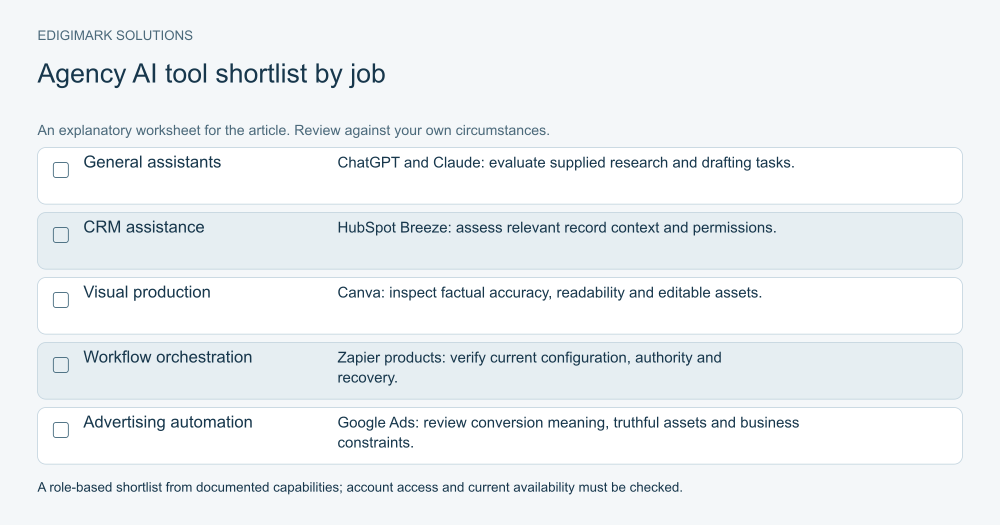
Use a role-based comparison rather than a single ranked list. A general assistant can help review supplied research or draft content. A workspace-oriented assistant can help organize maintained project context. A CRM assistant serves tasks inside a customer-record environment. A design tool supports editable visual production. An automation product connects a defined process across applications. Advertising automation acts within the campaign’s permitted environment.
These roles can overlap, but their responsibilities should not be interchangeable by assumption. A design assistant does not become the source of truth for product facts. An automation connector does not establish the eligibility rules it applies. A conversational answer does not replace the authoritative customer record.
Add one boundary beside each candidate. For research assistance, require source verification. For visual production, require factual and brand review. For CRM assistance, require accurate record context and permissions. For orchestration, require controlled actions and recovery. For advertising, require meaningful conversion definitions and truthful assets.
This comparison can include AI analytics tools without creating another subscription category automatically. Ask whether a product improves a defined analytical task, such as explaining an anomaly against supplied records. A generated narrative is useful only when it preserves the underlying data and does not invent causes.
What should an agency record after selecting an AI tool?
Document the approved job, account requirements, source owner, review standard and fallback process. Keep a concise list of tasks outside the tool’s authority. If it may prepare drafts but not publish, the operating process should preserve that distinction.
Retain representative examples for team training. Show a useful output, an unsupported claim and a failure that requires escalation. Practical examples help new staff apply the review standard more consistently than a broad instruction to “check everything.”
Review actual usage and completed-output effort before renewal. A subscription that is rarely used, duplicates maintained facts or creates repeated correction work deserves a concrete decision. Retiring an unsuitable tool can be a better outcome than finding more tasks merely to justify its presence.
Frequently asked questions
What is the best AI tool for a marketing agency?
There is no universal choice. Compare the actual task, account capabilities, data controls, integration and review effort. A shortlist by job is more useful than a general ranking.
Should an agency buy both ChatGPT and Claude?
Only if each provides useful value in your defined workflows. Use comparable tasks and record quality and effort. Overlapping subscriptions can add complexity without improving the operation.
Do AI design tools remove the need for review?
No. Check facts, text readability, editability, brand consistency and the actual distribution requirements. A conceptual visual should not be mistaken for measured data.
Is an automation platform safe to run without supervision?
Authority, data access and failure handling need a specific design. Drafting, routing and external actions require different controls. Test the complete workflow before expanding it.
How often should a tool comparison be refreshed?
Refresh it before a purchase or material rollout and when relevant features, pricing or integrations change. Keep the research date and account conditions visible.