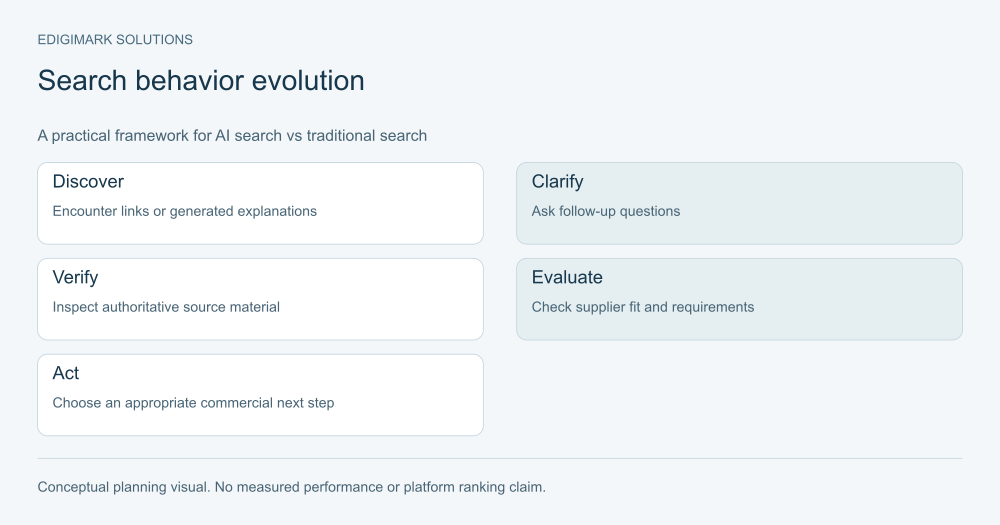
AI search vs traditional search changes the way information can be presented: a generated response can synthesize an explanation and suggest sources, while a conventional results page offers links for the user to inspect. Buyers can use both in one journey. Plan for discovery, verification and supplier evaluation rather than assuming a single interface determines every decision.
This comparison describes possible research patterns, not a universal measured change in user behavior. The journey examples are hypothetical. Interface, query, market and individual preferences can affect how a person searches and what they trust.
In this guide
- AI search vs traditional search: how does search discovery behavior differ?
- What changes in AI-assisted buyer research?
- How does traditional search still support investigation?
- How do AI answer journeys affect source verification?
- What would a mixed search journey look like?
- How should content support research across AI and traditional search?
- How should the website support the next research step?
- How should AI and traditional search discovery be measured?
- What should a practical search-behavior review ask?
- How should a traditional search comparison avoid unsupported generalizations?
- Frequently asked questions
AI search vs traditional search: how does search discovery behavior differ?
A traditional search interaction often begins with a query and a set of results. The user chooses a page, evaluates it and may return to search. An AI-assisted interaction can begin with a conversational question and an explanation that incorporates information from several sources.
Google’s generative-search guide describes retrieval and related query expansion within its features. The practical difference for a business is that a user can encounter an explanation of a category before visiting an individual supplier.
Neither experience removes the need for verification. A generated explanation can be incomplete or unsuitable for a specific situation. A conventional result can lead to outdated or unhelpful material. Users still need accurate source information and a way to examine relevant claims.
What changes in AI-assisted buyer research?
The user can ask for synthesis, comparison or follow-up clarification in a conversational form. A question such as “what should we check before migrating our CRM?” can invite a structured explanation rather than a single page title.
For a hypothetical operations manager, the first output may help identify requirements and terminology. The next step may involve checking official documentation, discussing the issue internally and examining suppliers. The answer is one part of research, not necessarily the final decision.
This creates a useful editorial priority: explain the real buying questions with clear scope and evidence. A supplier page should help someone verify whether the summarized capability actually applies to their circumstances.
Edigimark’s digital marketing services can organize resources around these decisions across search and direct evaluation.
How does traditional search still support investigation?
Conventional search can support precise navigation, comparison across results and direct inspection of source pages. A user may search a product name, documentation topic or exact technical error because they want the authoritative destination.
It can also help a person verify something encountered in a generated answer. A buyer might search the named supplier, inspect compatibility information and compare alternatives. The journey can move between the two experiences rather than replacing one with the other.
Maintain searchable, usable public resources. Clear page purpose, accurate titles and coherent internal navigation help the person continue the task after arriving. Avoid treating the website only as text to be extracted by another system.
How do AI answer journeys affect source verification?
An answer can compress information from several pages, which makes context important. A limitation or prerequisite may be omitted from a summary. The source page should make those conditions visible and easy to understand.
Use precise factual claims and maintain current capability information. If the public website, sales asset and documentation contradict one another, the buyer has a harder time determining which description is authoritative.
OpenAI’s crawler documentation distinguishes search discovery, training and user-initiated activity. These are separate controls and purposes. Do not assume that one generic AI bot setting governs every search or retrieval interaction.
Eligibility and access do not guarantee a citation or mention. Keep those events distinct when discussing visibility with stakeholders.
What would a mixed search journey look like?
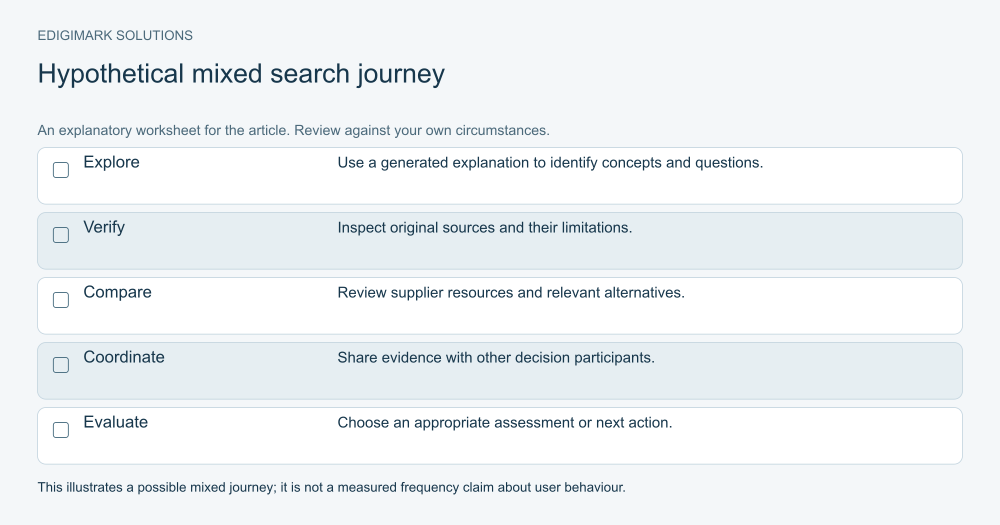
Consider a hypothetical B2B buyer evaluating marketing automation. They begin with a generated explanation of common lifecycle stages. They then search for implementation requirements, inspect several suppliers and ask colleagues about delivery responsibilities.
The buyer may return to an AI interface to compare approaches or clarify terminology. Before contacting a supplier, they examine scope, supported systems and the expected assessment process on the supplier’s own site.
This journey illustrates several content jobs: category education, implementation clarity, transparent comparison and a useful commercial next action. It does not establish that every buyer follows the same sequence or that an AI answer caused the final enquiry.
Marketing automation services and CRM integration services provide relevant commercial destinations when those are the actual implementation tasks. Contextual links should help the reader continue the decision.
How should content support research across AI and traditional search?
Write resources that stand alone and connect to adjacent decisions. Give a direct answer, then explain conditions, examples and trade-offs. Use descriptive headings so a visitor can navigate to the information they need.
Keep different pages useful for different tasks. A foundational explanation, comparison and technical implementation guide need distinct scope. Avoid publishing many pages that simply rephrase the same broad advice.
Add original decision value. A clearly labeled workflow example or practical worksheet can help a reader apply the information. Unsupported statistics or invented first-hand experience create the appearance of authority without dependable substance.
Maintain sources and review dates for facts likely to change. A generated answer may point to your page because it appears relevant; the arriving user needs current information to assess it.
How should the website support the next research step?
Make fit, scope and prerequisites visible. Provide reliable navigation between educational and commercial resources. A person arriving from either search experience should understand what the business offers and which action is useful.
Check mobile readability, forms and confirmation. A good explanation loses practical value when the assessment route fails or promises a response the team cannot deliver.
Web development services can support accessible page structure and dependable public behavior. Conversion rate optimization services can assess the clarity of the exchange and the quality of subsequent enquiries.
Do not replace the website with a collection of fragments designed only for extraction. The resource needs enough context for a human decision, including limitations and implementation requirements.
How should AI and traditional search discovery be measured?
Use the reports actually available for each platform and site. Google’s Generative AI performance report provides a documented view for its own Search generative features. It does not measure every external AI service.
Keep mentions, citations, impressions, referrals and commercial actions separate. A brand mention without a link has a different meaning from an observed visit. A visit has a different meaning from an accepted enquiry. Do not collapse them into one universal “AI visibility” score without definitions.
Use buyer-reported discovery information when appropriate. It can reveal a colleague recommendation or earlier answer that tracking did not capture. Preserve it alongside tracked source information rather than forcing the two to agree.
Data analytics services can combine these signals with clear coverage and limitations. Attribution should remain an evidence view rather than a confident claim to observe the entire decision process.
What should a practical search-behavior review ask?
Ask which questions relevant buyers investigate, which resources help them verify the answer and where their evaluations stall. Review actual enquiries and sales questions alongside platform reports.
Avoid reacting to a generic claim that every user has abandoned one search method. Your audience may use several routes. The useful planning question is whether the business provides accurate information and a dependable next step at the relevant research moments.
Test content and conversion improvements with a clear hypothesis. A better compatibility resource may help both search experiences and direct referrals. A repaired enquiry path may improve the commercial outcome regardless of how the visitor first discovered the business.
Contact Edigimark to map discovery, verification and evaluation tasks, then prioritize resources that help your audience make an informed decision.
How should a traditional search comparison avoid unsupported generalizations?
Describe the task and evidence you actually reviewed. A hypothetical journey can explain how someone might move from a generated summary to source pages and supplier evaluation, but it does not establish how often users behave that way.
For an observed journey, record the available sources and limits. Interviews report what participants remember; analytics records selected interactions; platform reports cover their own definitions. These views can complement one another without becoming a complete record of every discovery step.
Use the comparison to improve resources and verification paths. Avoid declaring that one experience has replaced the other without appropriate evidence for the audience, period and task being discussed.
Frequently asked questions
Will AI search replace traditional search completely?
That cannot be stated as an established outcome. People can use multiple research methods. Plan for mixed journeys and update decisions using evidence from your audience and current platforms.
Does a generated answer mean users no longer visit websites?
Some questions may be resolved within an interface; others require source inspection or supplier evaluation. The effect varies by task. Measure relevant referrals and commercial actions rather than assuming one universal behavior.
Is AI search visibility the same as ranking?
No. A citation or mention within an answer is a distinct event from a conventional result position. Define what is being observed and use the appropriate report or research method.
Should every page have a short direct answer?
A clear opening can help many informational tasks, but context and exceptions still matter. Structure the resource for the reader’s decision rather than following a rigid formatting rule.
What is the most useful immediate change?
Review whether your important pages explain fit, claims and implementation clearly, and whether the commercial next action works. These foundations support several discovery routes without relying on a prediction about one interface.