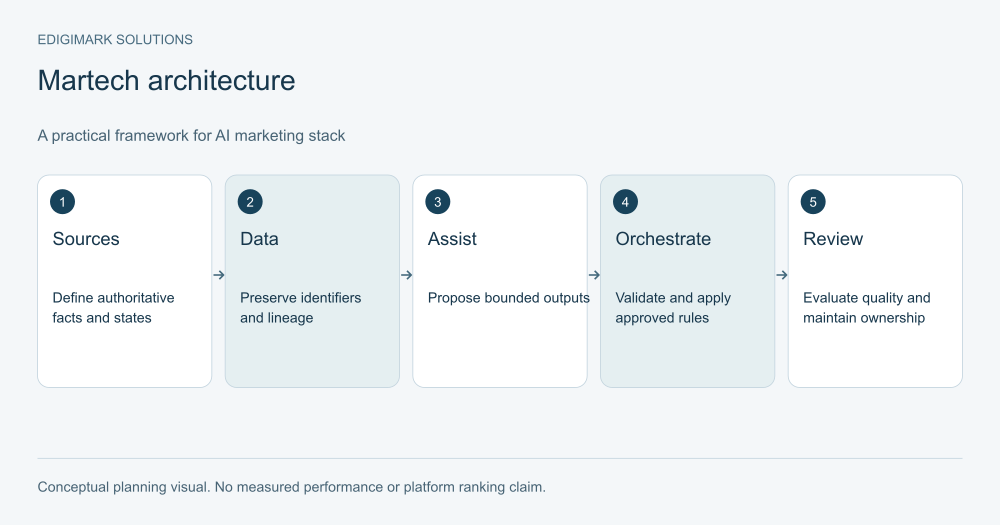
An AI marketing stack connects authoritative business data, CRM, analytics, content and bounded AI workflows around specific marketing tasks. Start with the operating need and data ownership, then choose integrations and tools. The architecture should make it clear which system holds the facts, which component proposes an output and which person or rule authorizes an action.
Buying more products does not automatically create a connected stack. A useful system preserves identifiers, preferences, evidence and responsibility across the journey. A collection of assistants with conflicting facts can create more work than a simpler, well-maintained architecture.
In this guide
- What should AI martech architecture start with?
- Which data, assistance and workflow layers belong in the stack?
- How should the marketing data layer preserve trust?
- What does CRM AI integration need beyond an app connection?
- How should a content and claim library work?
- Which bounded AI marketing tasks are useful to pilot first?
- How should workflow orchestration handle authority?
- How should AI marketing workflows handle failures?
- What does AI workflow governance look like in practice?
- Should you buy or build the AI marketing stack?
- How should an AI stack pilot handle implementation enquiries?
- How should an AI stack roadmap sequence data and workflow work?
- What fields should a reviewed enquiry summary preserve?
- How should the pilot handle duplicate and partial requests?
- How should AI stack changes be reviewed before wider use?
- Frequently asked questions
What should AI martech architecture start with?
Start with the business task and required outcome. Examples include summarizing enquiries for review, selecting an approved resource, preparing a campaign report or checking a draft against product facts. Each task needs a defined input and inspectable output.
Write the operating boundary. A component may draft a response without being authorized to send it. It may suggest a CRM update without being authorized to change the commercial record. It may summarize data without being allowed to collect unrelated information.
Inventory the current systems before adding another tool. Identify where customer, company, opportunity, content and transaction information lives. Determine which source is authoritative for each important fact and who maintains it.
Edigimark’s AI-powered solutions can help translate a proposed use case into a bounded architecture. The first deliverable should be a workflow specification, not a shopping list.
Which data, assistance and workflow layers belong in the stack?
| Layer | Responsibility | Typical evidence to maintain |
|---|---|---|
| Business source systems | Hold authoritative facts and states | Field owners, identifiers and definitions |
| Marketing data layer | Organize permitted data for the task | Joins, timestamps, coverage and lineage |
| Content and claim library | Preserve approved resources and factual scope | Sources, review dates and owners |
| AI assistance | Propose a bounded analysis or output | Task definition, inputs and uncertainty |
| Workflow orchestration | Apply routing, validation and approved actions | Rules, suppression, retries and audit history |
| Human review and measurement | Verify quality and decide improvements | Evaluation cases, findings and outcomes |
These are logical responsibilities. A small business may implement several within existing applications. It does not need a separate enterprise product for every row.
How should the marketing data layer preserve trust?
Use dependable identifiers and documented relationships. Contacts, accounts, opportunities and transactions have different meanings. Several people can participate in one company evaluation, and one company can have several legitimate opportunities.
Preserve source dates and state history where the task needs them. A current account summary should not silently reuse an old opportunity status. A campaign report should not compare stage definitions that changed halfway through the period without explanation.
Keep unknown coverage visible. Missing source or association information should remain a reviewable status rather than being filled with an invented relationship. The layer should make analysis reproducible, not merely produce a tidy table.
Data analytics services can help define the joins, metric dictionary and reconciliation that this layer requires.
What does CRM AI integration need beyond an app connection?
Define field ownership, permitted access and allowed updates. The CRM may own commercial stage and account responsibility. The marketing platform may own preference state. Finance may own the revenue convention used in reporting.
An app connection establishes a technical path, but it does not resolve conflicts. If two systems write different values to the same field, specify which takes precedence and under what circumstances. Test retries and stale data so an old automation does not reverse a newer sales decision.
HubSpot’s Breeze Assistant documentation notes that permissions govern available actions. Apply that principle to your architecture: tool capability and user authority are separate conditions.
CRM integration services can support identifiers, duplicate handling, record associations and stage authority. Review the complete journey rather than assuming synchronization alone creates commercial truth.
How should a content and claim library work?
Maintain approved capability descriptions, service scope, technical requirements and source references. Assign owners and review dates. Distinguish published material, working drafts and unresolved research questions.
AI workflows can use this library to produce briefs, adapt explanations and check drafts. They should identify which source supports each important claim. A missing fact should lead to a question or review state rather than a fabricated detail.
Keep limitations with the facts. A claim that a product supports a workflow may depend on permissions or configuration. A shortened version that removes those prerequisites can mislead even when the remaining sentence is grammatically correct.
Content owners should review the library when product or service scope changes. Otherwise, the stack can generate consistent but outdated material across several channels.
Which bounded AI marketing tasks are useful to pilot first?
Start with assistance whose output is easy to inspect. Classification, summarization, brief review and reporting narration can have clear source material and reviewers. A broad autonomous instruction to manage the entire marketing function lacks a dependable boundary.
Require the task, expected output and uncertainty handling. The component should distinguish supplied facts from hypotheses and preserve references to original material. Its output needs validation before it becomes input for an external action.
OpenAI’s Structured Outputs documentation describes constrained output formats for API workflows. A valid structure can help integration, but it does not guarantee that the facts inside the structure are correct. Validate content as well as format.
Choose product and model features according to the actual task and account. Avoid promising capability based on a general announcement without checking the specific integration.
How should workflow orchestration handle authority?
Separate proposal from action. A model can propose a resource match, but preference and commercial-state rules govern whether a message may be sent. A model can suggest a record correction, but the responsible owner or approved validation governs application.
Create explicit action types. Drafting, internal routing, record creation, customer messaging and publication carry different operating consequences. Each needs a defined authorization, validation and failure path.
Use marketing automation services to connect authoritative states, suppression and approved transitions. The architecture should include pause and review states rather than forcing every input towards an immediate action.
Log enough information to understand the decision: input version, rule or task version, proposed result, validation status and applied action. Avoid collecting unnecessary sensitive information merely to make logs more detailed.
How should AI marketing workflows handle failures?
Test missing data, invalid structure, uncertain classification, unavailable applications and partial writes. A retry should not create duplicate contacts, send duplicate messages or apply the same commercial change twice.
Preserve the original request when an integration fails. Use a visible retry or review state and a responsible owner. Silent loss is especially damaging when the customer believes an assessment or response has been requested.
Distinguish failure types. A model omission needs a different correction from a data-join error or an expired application connection. The operational dashboard should make these cases diagnosable.
Keep a conventional fallback for important customer paths. If an AI summary fails, the owner should still be able to inspect the original enquiry and respond appropriately.
What does AI workflow governance look like in practice?
Assign a workflow owner, source owner, reviewer and action owner. One person can hold several roles in a small team, but the responsibilities should remain explicit. Changes to tools, prompts or data sources need a review proportionate to their effect.
Use representative evaluation cases. Include normal inputs, ambiguous requests, unsupported claims, missing fields and failures. Record both accuracy and review effort. A workflow that produces more drafts but requires much more correction may not improve the task.
Version prompts and rules. OpenAI’s production prompting guidance emphasizes evaluation and versioned prompt management. Preserve the same discipline in your operational system even when the interface is a no-code tool rather than a custom application.
Review access when team members or client responsibilities change. The architecture should reflect actual authority, not retain broad access because an earlier pilot once required it.
Should you buy or build the AI marketing stack?
Buy when a supported product fits the task, integration, access and review requirements with acceptable operating effort. Build when a necessary workflow cannot be supported adequately and the organization has the capacity to develop and maintain it.
Include total ownership cost: configuration, integration, evaluation, training, review, troubleshooting and supplier changes. A custom component is not free because the initial code is small. A purchased tool is not automatically low effort because it advertises many connectors.
Test a bounded use case before making a long-term commitment. Compare the completed useful output, error categories and maintenance requirements. Do not choose solely from a feature checklist or a single impressive demonstration.
Web development services can support reviewed custom interfaces and integration work when the architecture warrants it.
How should an AI stack pilot handle implementation enquiries?
Consider a hypothetical B2B consultancy processing implementation enquiries. The form captures a stated problem and contact method. The CRM holds the request and authoritative owner. Approved qualification criteria and service resources sit in a maintained library.
An AI component proposes an enquiry category and concise summary. It marks missing information and does not infer budget or purchase intent. A workflow validates the output, checks record state and routes a review task. A person inspects the original request and decides the response.
The pilot measures classification errors, omissions, unsupported assertions, routing reliability and review effort. It tests duplicate submissions, existing customers, support requests and failed writes. No autonomous customer message is required to establish whether the summary workflow is useful.
This architecture connects data, AI assistance and operations with a clear authority boundary. If the pilot is dependable, the team can consider additional tasks separately rather than granting broad authority all at once.
How should an AI stack roadmap sequence data and workflow work?
First repair authoritative data and ownership. Then build or maintain the approved resource library. Define one bounded task, implement its validation and failure path, and test it with representative cases. Finally connect it to a limited operational action if that action is authorized and useful.
Review the workflow after changes to sources, models or applications. Track whether the output remains useful and whether review burden changes. Retire duplicate components that maintain conflicting truth or unclear responsibility.
Connect the stack to your commercial strategy. Digital marketing services can help prioritize the task that supports a real audience or operating need. Contact Edigimark to map the data, workflow and review responsibilities before expanding the architecture.
What fields should a reviewed enquiry summary preserve?
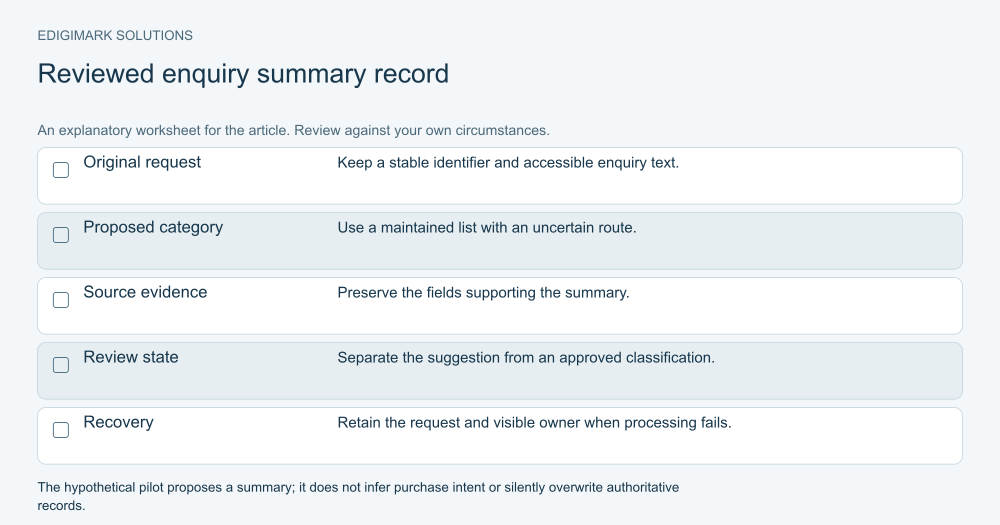
For the hypothetical consultancy pilot, define an output record before connecting applications. It might contain the original request identifier, proposed category, concise summary, missing information, supporting source fields, uncertainty flag and review status. Keep the original enquiry accessible beside the generated summary.
The category should come from a maintained list, with an “uncertain” or review route when the input does not fit. The summary should report what the person actually supplied rather than infer commercial intent. Missing budget information should remain missing, not become a plausible estimate.
Supporting source fields make review easier. A proposed “integration assessment” category could refer to the enquiry text naming two systems, while an unclear request should show why classification is uncertain. The reviewer should be able to inspect the underlying evidence without reconstructing the model’s entire interaction.
The output record should not silently overwrite authoritative CRM fields. A suggestion and an approved classification are different states. Preserve who reviewed the suggestion, when the decision occurred and which version of the rules applied.
How should the pilot handle duplicate and partial requests?
Use a stable request identifier to connect the form, CRM record and review task. If the same submission is retried, the workflow should recognize that it has already been received. A new request from an existing contact may require a new enquiry record rather than a duplicate person record.
Define incomplete states explicitly. A CRM write can succeed while the summary step fails. The record should remain available with a visible processing or review status. The failure must not erase the original request or imply that the customer never submitted it.
Specify the recovery action for each failure type. Missing input may need clarification; an invalid category may need reviewer assignment; an expired connection may need an integration owner; a transient service failure may permit a controlled retry. Avoid one generic retry rule that repeats every side effect.
The operational queue should expose age and ownership. A request waiting for technical recovery still needs a responsible person who can use the fallback path. Otherwise a technically recoverable failure can become an unhandled customer enquiry.
How should AI stack changes be reviewed before wider use?
Treat source changes, prompt changes, model changes and connected-application changes as distinct events. A revised service library may alter factual scope. A new prompt may change omission patterns. A new connection may create action authority the original pilot never tested.
Select relevant regression cases from the pilot set. Check normal enquiries, ambiguous inputs, repeated submissions and failed writes. Compare factual support and review effort with the previous version rather than assuming a newer component automatically improves the process.
Record the release decision and rollback route. The owner should know which configuration is live and how to restore a previous dependable version if the new behaviour is unsuitable. Include the human fallback in the release plan.
Finally, review the architecture at the task level. If two products propose conflicting summaries or maintain different claim libraries, the solution may be to simplify the stack. More connected components create more maintenance relationships; each should have a clear reason to exist and an accountable owner.
Frequently asked questions
Does an AI marketing stack require a data warehouse?
Not always. The architecture needs dependable data relationships and definitions. A small workflow may operate within existing applications. Choose infrastructure according to the task, scale and maintenance capacity.
Can one assistant replace the whole stack?
An assistant can support tasks, but authoritative records, permissions, workflow rules and commercial definitions still need owners. Do not assume conversational access resolves those operating responsibilities.
Does structured output make automation reliable?
It can improve format predictability. Reliability also requires factual validation, authoritative inputs, duplicate handling, authorization and failure paths.
Which workflow should be automated first?
Choose a recurring bounded task with inspectable output and manageable consequences, such as enquiry summarization or draft review. Evaluate it before expanding action authority.
How do you avoid tool sprawl?
Use a workflow inventory, shared source ownership and a concrete task for every product. Remove overlap that creates conflicting facts or unnecessary maintenance without useful value.