
AI marketing automation use cases are most useful when they assist a defined task with dependable inputs, an accountable owner and an appropriate review gate. Start with classification, summarization, drafting and monitoring before granting a system authority to contact customers, publish claims or change commercial records. Evaluate the workflow’s accuracy and usefulness, not simply the number of tasks automated.
The following 25 ideas are a practical planning library. They describe possible workflows rather than guaranteed features in every product. Availability, data access and implementation depend on the tools and account you use.
In this guide
- How should you select AI marketing automation use cases?
- Which AI lead qualification and sales-support ideas are practical?
- Which AI content operations can improve editorial work?
- Which AI personalization workflows can remain useful and bounded?
- Which AI marketing reporting and analysis tasks are useful?
- Which AI campaign operations and quality checks can help?
- How do you evaluate an AI automation pilot?
- What should the AI automation implementation plan prioritize?
- What should an AI automation use-case approval card contain?
- Frequently asked questions
How should you select AI marketing automation use cases?
Choose tasks that recur, have a clear output and can be evaluated against examples. An enquiry summary has an identifiable source and a reviewer. An instruction to “grow the business autonomously” lacks a dependable boundary.
HubSpot’s Breeze Assistant documentation describes assistance with content, record summaries and tasks, with permissions determining available actions. This illustrates why capability and account access must be checked separately from an attractive use-case idea.
For each workflow, write the input, expected output, allowed action, reviewer and failure path. Use only authorized data. Test ambiguous inputs and unsupported cases before expanding volume. The ideas below identify a specific job and the control that keeps it useful.
Which AI lead qualification and sales-support ideas are practical?
1. Classify inbound enquiries by requested task
Use the original enquiry to suggest categories such as implementation assessment, support, partnership or general education. Preserve the original wording and send uncertain cases to review. Classification should support routing rather than inventing a commercial need. Evaluate mistakes by category because a support request incorrectly sent to sales needs a different repair from a relevant enquiry sent to a general queue.
2. Summarize an enquiry for the receiving owner
Create a concise summary of the stated problem, supported systems, requested next step and missing information. Link it to the underlying record. The summary must not imply that an inferred budget, role or timeline was supplied by the prospect. A reviewer should be able to identify every important assertion in the original material.
3. Suggest qualification questions
Compare the enquiry with approved fit criteria and propose questions that would resolve meaningful uncertainty. For a technical assessment, the missing item might be a supported system or implementation owner. Avoid requesting unnecessary personal information. The receiving person decides which questions are appropriate and whether the existing evidence already supports the next action.
4. Prepare an account meeting brief
Combine authorized CRM context with verified account research to summarize current relationship, known evaluation questions and outstanding decisions. Separate confirmed information from hypotheses. Include source dates so a reviewer can detect stale facts. The brief supports preparation; it should not manufacture private purchase intent from public hiring or growth signals.
5. Draft a relevant follow-up response
Use the prospect’s request and approved resources to propose a reply that answers the actual question. Keep delivery promises, scope and scheduling conditional on verified availability. A responsible owner reviews and sends the response. Automating the draft can save composition work without granting the model authority to create an unsupported commercial commitment.
Which AI content operations can improve editorial work?
6. Cluster supplied buyer questions
Group an authorized question list by the decision each question represents. Return proposed clusters, ambiguous items and the reason for separation. Do not invent search volume or claim the groups are validated demand. An editor checks whether the clusters reflect distinct reader tasks and consolidates variants that would otherwise produce repetitive pages.
7. Build a brief from approved evidence
Turn a topic, audience description, product facts and source material into a proposed content brief. Require each factual claim to identify its source or remain a research question. The output should define the reader’s decision, useful sections and exclusions. This is more dependable than asking for an authoritative article on a topic with no supporting context.
8. Review an outline for missing decisions
Ask the system to compare the outline with the reader’s task and identify unanswered implementation, comparison or fit questions. It can also flag overlapping sections. The editor decides which gaps matter. This review is useful before drafting because it can improve structure without encouraging additional pages or extra words that add no decision value.
9. Check a draft against a claim ledger
Compare statements in a draft with approved product and evidence records. Flag unsupported numbers, stronger promises and inconsistent scope. Do not treat the model’s agreement as independent verification. The owner resolves each flag using the underlying source. This workflow is particularly useful when several writers use the same changing capability information.
10. Repurpose an approved resource
Adapt a verified guide into an email, short presentation or social explanation while preserving its factual limits. Ask for a list of claims changed or omitted. Review the adaptation for misleading simplification. A caveat essential to a buying decision should not disappear merely because the new format has fewer words.
Which AI personalization workflows can remain useful and bounded?
11. Select a resource for a stated question
Match a known prospect’s actual question to a maintained resource library. Return the resource, relevance explanation and any uncertainty. If no suitable resource exists, create a review task rather than inventing an answer. Keep communication preferences and active sales status outside the model’s discretion so a relevant match does not automatically authorize sending.
12. Adapt an explanation to a buying role
Rewrite approved information for a technical reviewer, operations owner or commercial approver. Change emphasis while preserving capabilities and requirements. The adaptation should help a specific responsibility, not imply knowledge of the reader’s private circumstances. Review whether the shortened version still communicates limitations and the next useful decision.
13. Draft lifecycle messages for a verified state
Use an authoritative lifecycle state to draft onboarding, evaluation or educational content. The state and enrollment rule should come from the approved system, not a model inference based on incidental activity. A customer should not receive acquisition messaging because the system guessed they were a new prospect from a website visit.
14. Suggest a next useful content asset
Review authorized interaction and enquiry themes to suggest gaps in the resource library. Require the suggestion to identify a recurring buyer question and the evidence supporting it. The editorial team prioritizes the work. This helps personalization improve through better shared resources rather than an endless stream of individually generated explanations with inconsistent facts.
15. Review message relevance before delivery
Compare a proposed message with the stated exchange, audience and current commercial state. Flag contradictions, repeated requests and unsupported familiarity. A sending system still needs explicit permission and suppression logic. The review can identify mistakes, but it does not make an otherwise inappropriate message suitable merely because the wording sounds personalized.
Which AI marketing reporting and analysis tasks are useful?
16. Summarize a reconciled campaign report
Provide a defined table with metric meanings and ask for a concise account of observed changes, missing information and likely questions. Require the output to separate observation from explanation. A decline in accepted enquiries is observable; the claim that a competitor caused it needs evidence. The analyst verifies every number and denominator before sharing the summary.
17. Flag inconsistent metric definitions
Compare dashboards or reporting specifications for mismatched terms such as lead, opportunity, revenue and cost. Return the conflicting definitions and affected decisions. The metric owner resolves them. This can prevent a precise comparison that actually joins unlike measures, especially when one report counts people and another counts companies or deals.
18. Triage unusual performance changes
Identify unexpected changes in a supplied time series and propose checks for tracking, delivery and audience differences. Use the model to organize investigation, not to declare a cause. An apparent conversion drop could reflect a broken form, changed event definition or genuine audience response. Verify the underlying records before changing campaign investment.
19. Draft a data-quality investigation plan
Given a reconciliation mismatch, propose checks for missing identifiers, duplicates, timestamps and commercial adjustments. Keep the actual repair under a responsible data owner. The workflow is useful when it turns an unclear complaint into a reproducible investigation. It should not silently rewrite records to make totals align.
20. Create a reporting question backlog
Summarize recurring stakeholder questions and map them to available evidence, missing data and a decision owner. This helps reporting work prioritize useful analysis. Avoid expanding collection simply because an interesting question exists; assess whether the decision warrants the data and whether the organization can collect and use it appropriately.
Which AI campaign operations and quality checks can help?
21. Review an advertisement against the destination
Compare the ad’s promise with the landing page and approved offer. Flag mismatched scope, unsupported results and a next action that differs from the advertisement. A human owner resolves the issue before launch. This workflow focuses on truthful continuity rather than generating increasingly aggressive claims to improve a superficial click metric.
22. Check an email’s promised exchange
Compare the message with the signup or enquiry context. Flag a missing promised resource, an unexpected commercial request or a contradiction in follow-up timing. Delivery requirements still need separate verification. Google’s sender guidance is a current reference for applicable Gmail traffic, not a substitute for relevant communication and preference handling.
23. Generate authorized test scenarios
Use a workflow specification to propose cases for new records, duplicates, uncertain fit, preference changes and failures. A technical owner creates appropriate test data and verifies actual behavior. Test generation helps widen review beyond the happy path. It does not prove the system passed simply because the cases were described clearly.
24. Review a form and confirmation message
Inspect supplied form text and expected behavior for ambiguous requirements, misleading promises and unclear confirmation. The system can propose clearer wording and accessibility questions. A developer or product owner verifies the real experience. Keep the distinction between editorial review and functioning implementation visible in the task definition.
25. Maintain a workflow change summary
Turn approved changes into a concise record of the rule, effective date, owner and expected impact. Link to the implementation and test evidence. This helps future reviewers understand why behavior changed. The summary must describe completed changes accurately, rather than converting a planned modification into a claim that the system has already been updated.
How do you evaluate an AI automation pilot?
Use representative cases and compare the result with the expected task. Measure unsupported claims, classification errors, omissions, unnecessary data use and the review effort required. A workflow that produces more drafts while requiring more correction may not improve the operation.
Include ambiguous and failing inputs. Missing context should lead to a question or review state, not confident invention. A retry should not trigger duplicate messages or repeated record creation. Keep the model’s drafting role distinct from the system that authorizes an external action.
OpenAI’s prompting guidance recommends testing and versioned prompt management for production work. Apply the same discipline to your workflow: preserve the task definition, sample cases and the changes that alter behavior.
What should the AI automation implementation plan prioritize?
Start with one bounded use case and a named owner. Summarization or editorial review is often easier to inspect than an autonomous customer-facing action. Define success through useful accuracy and manageable review, then expand authority only when the operation supports it.
Edigimark’s AI-powered solutions can help scope the workflow. Marketing automation and CRM integration connect authoritative states and records, while data analytics supports reliable evaluation.
If the goal is a customer-facing experience, web development services can support accessible interfaces, confirmation and failure paths. Contact Edigimark to select a use case with a clear task, dependable evidence and a realistic review process.
What should an AI automation use-case approval card contain?
For an enquiry-summary pilot, include concrete cases in the approval record. An ordinary implementation question should preserve the named systems and requested help. A support complaint should remain a support request rather than being reclassified as a sales opportunity. An incomplete enquiry should expose missing context instead of inferring a budget or purchase deadline.
| Pilot case | Expected reviewable behaviour | Check before approval |
|---|---|---|
| Implementation question | Summarize the supplied scope | No invented capabilities or commitments |
| Support complaint | Preserve the customer’s stated problem | Correct operational routing |
| Missing information | Identify the unanswered question | No inferred commercial facts |
These are hypothetical test expectations, not measured results. The pilot owner should compare the generated summary with the original material and inspect the resulting review task. A correct category is insufficient if the request reaches no accountable owner or its source context disappears.
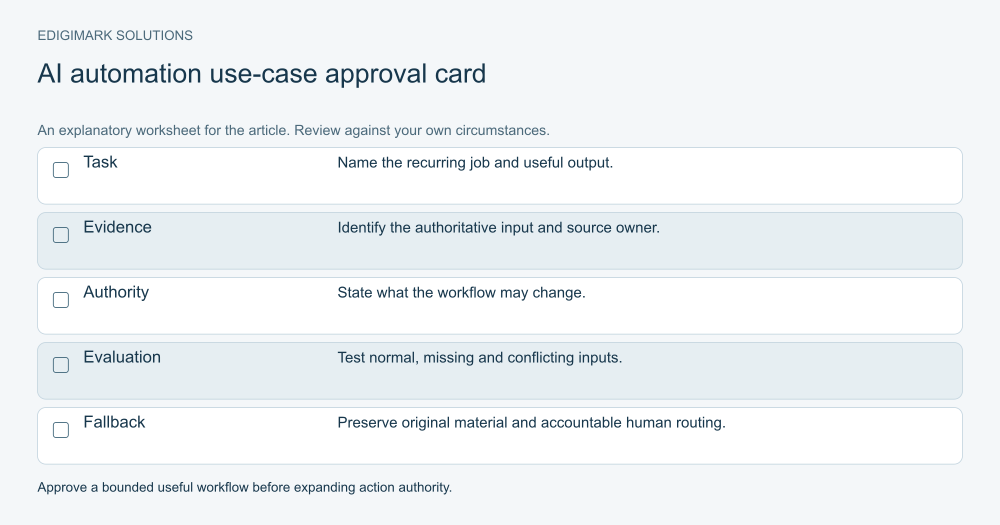
Before implementing one of these ideas, write a short card naming the recurring task, authorized input, proposed output and reviewer. Identify the source of truth and what the workflow may change. A task that drafts a summary has a different authority boundary from one that assigns a lifecycle stage or sends a customer message.
Add representative cases and acceptance criteria. Include normal input, missing context, contradictory records and unsupported claims. Specify what the assistant should do when the evidence is insufficient. “Ask for review” is an operating result, not necessarily a failed use case.
Estimate the full effort: setup, source preparation, generated output, checking, correction and maintenance. Measure completed useful work rather than output volume alone. If a pilot produces many drafts that reviewers cannot approve, the process may need better inputs or a narrower task.
Finally, name the fallback. The customer or internal team should not lose a request because an AI component is unavailable. Preserve the original material and route it to an accountable person. Approve expansion only when the bounded process remains useful under ordinary exceptions.
Frequently asked questions
Which AI automation use case should a small team start with?
Choose a recurring, bounded task with an inspectable output, such as summarizing enquiries or reviewing a draft against approved claims. Start where review is practical and the result supports a clear next action.
Can AI lead qualification replace sales judgement?
It can assist with classification and evidence summaries. Fit, uncertainty and commercial context still need approved criteria and a review path. A model should not invent missing purchase intent.
Does a structured output guarantee factual accuracy?
No. A well-formed record can contain wrong information. Validate both the structure and the underlying claims before a workflow acts on the result.
Should AI-generated messages be sent automatically?
Only under an explicitly designed and authorized operation with appropriate data, preferences, suppression, evaluation and failure handling. Draft assistance and sending authority are separate decisions.
How do you judge whether the pilot is worthwhile?
Compare accuracy, useful throughput, review effort, failure handling and the downstream task. Do not count generated outputs alone as business value.