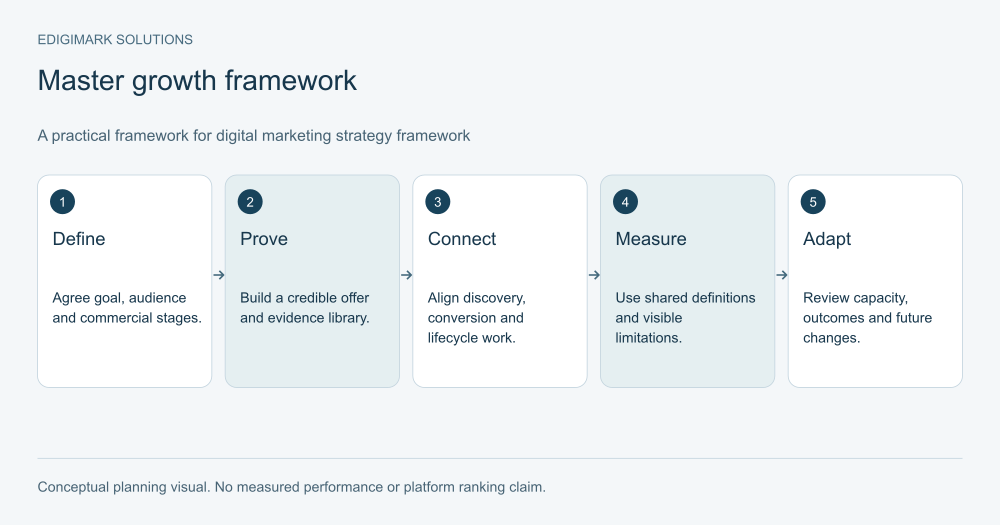

AI in digital marketing is changing how teams research, create, distribute and review work, while also changing how people discover information. A useful 2027 plan should connect those changes to your audience, data and operating responsibilities. Use AI where a defined workflow benefits from assistance, and preserve human accountability for factual claims, commercial decisions and customer experience.
This is a planning guide written using information available in October 2026. It describes current capabilities and reasonable priorities for 2027, not future events that have already happened. Specific product features, prices and availability should be checked when an implementation decision is made.
In this guide
- How is AI in digital marketing changing the workflow?
- How should businesses respond to AI search changes?
- What do AI advertising workflows change?
- How should AI affect content production?
- What does useful AI personalization require?
- How can AI marketing analytics improve reporting?
- Which data responsibilities support reliable AI marketing work?
- How should an organization govern AI-assisted work?
- Which AI marketing foundations are useful to fund for 2027?
- What should an AI planning worksheet contain?
- What should a 2027 AI marketing review change?
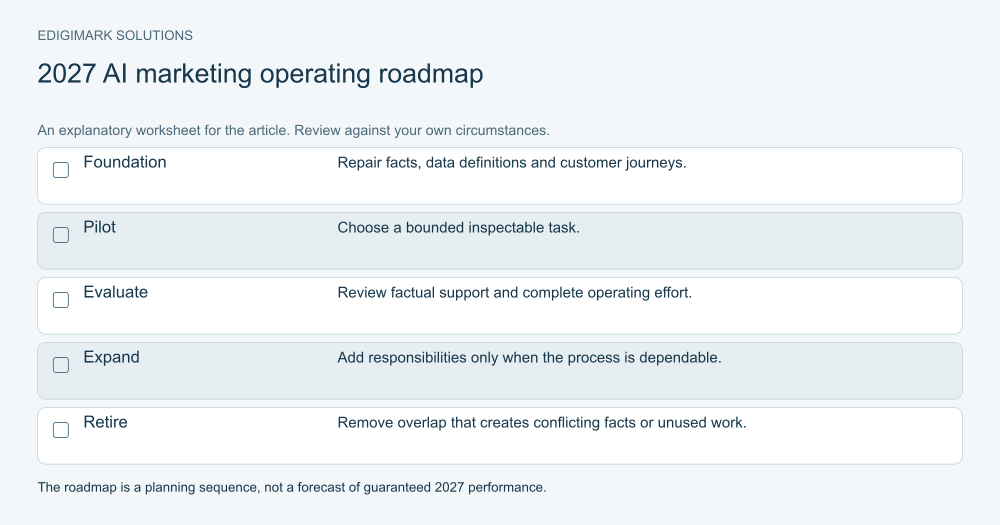
- How should the AI marketing roadmap sequence 2027 priorities?
- Frequently asked questions
How is AI in digital marketing changing the workflow?
AI can help organize supplied information, draft variations, summarize records and propose analyses. These tasks reduce some production friction, but useful output still depends on context and review. A fluent draft can contain an unsupported claim, and a clear summary can omit the detail that changes a decision.
The operating shift is from manually composing every output to specifying, checking and improving the workflow that produces it. Teams need better source records, task definitions and evaluation cases. Without those foundations, they can produce more material while becoming less certain about its quality.
Start by identifying recurring work with an inspectable result. A campaign summary, enquiry classification or outline review has a definable task. “Use AI to improve marketing” does not. The task needs an owner, allowed data, expected output and failure path.
Edigimark’s AI-powered solutions can help scope these operational applications around actual business needs rather than a broad technology ambition.
How should businesses respond to AI search changes?
Search experiences can combine a generated explanation with links to supporting material and further investigation. A buyer may encounter an answer before visiting a supplier’s site. The business still needs accessible, accurate resources that help the buyer evaluate the offer when they arrive.
Google’s generative search optimization guidance continues to emphasize useful content and technical clarity. The practical priority is to improve the site’s real decision value rather than pursue speculative formatting tricks.
Explain capabilities, prerequisites, scope and limitations clearly. Maintain consistent business and product information. Distinct resources should serve distinct decisions: a problem explanation, comparison, compatibility resource and assessment page should not all repeat the same introduction.
Do not promise mentions or citations in a generated answer. Eligibility, discovery and selection are different events. Search systems and interfaces vary, and observed visibility can change with the query, location and time.
What do AI advertising workflows change?
Advertising platforms already use automation in bidding and creative assembly. Google’s Smart Bidding and Smart Creative documentation describes automated bid and asset-combination functions. The marketing team still determines the offer, assets, conversion definitions and commercial constraints.
AI increases the importance of accurate inputs. If a conversion represents any form submission rather than a useful commercial action, optimization may pursue the wrong outcome. If creative assets contain inconsistent promises, assembling more variations can spread that inconsistency.
Review the connection between the ad, landing page and follow-up. The advertisement should accurately represent the offer; the page should explain fit; the response should deliver the promised exchange. Automation cannot repair a misleading proposition simply by finding more people willing to click it.
For 2027 planning, prioritize reliable measurement, useful creative variation and clear business constraints before adding more automation. Treat platform recommendations as inputs to review rather than proof that every proposed change benefits your economics.
How should AI affect content production?
Use assistance for research organization, brief preparation, outline review and editing against approved facts. Provide original expertise, source material and the reader’s task. The output should add a useful explanation or decision framework rather than restate common material at greater volume.
Google’s AI-content guidance permits useful assistance while warning about pages generated without added user value. The production method alone is not a complete content strategy.
Maintain a claim ledger for important facts. Product capabilities need an authoritative owner. Statistics need an actual source and method. Illustrative examples need labels. A model-generated citation should be opened and checked before the claim is retained.
Preserve editorial judgement about whether a page should exist. Different keyword wording does not automatically justify another article. Consolidate topics that represent the same reader task, and reserve separate pages for distinct decisions.
What does useful AI personalization require?
Personalization should help a person complete a relevant task. It can organize resources around a stated question, adapt an approved explanation for a buying responsibility or support a verified lifecycle stage. It should not invent familiarity or private intent.
Use authoritative data for status and preferences. A customer state, sales opportunity or communication choice should come from the system responsible for it. A model should not infer that a visitor is a new prospect when they may be an existing customer seeking support.
Start with shared segment resources before generating endless unique messages. If many buyers ask the same implementation question, a maintained resource can provide more consistent answers than individual drafts that each require factual review.
Marketing automation services can connect personalization with lifecycle rules, suppression and exceptions. The system should support relevant quiet states as well as messages.
How can AI marketing analytics improve reporting?
AI can help summarize defined data, identify unusual changes and propose investigation questions. An analyst must still verify calculations, denominators, joins and explanations. A correlation in a table should not automatically become a causal claim.
Provide a metric dictionary with the input. Distinguish visits, enquiries, accepted leads, opportunities and revenue. State whether a report counts people, companies or deals. Without these definitions, even an accurate mathematical summary can misrepresent the business question.
Use the model to separate observed facts, possible explanations and missing evidence. For example, a decrease in accepted enquiries is an observation. A broken form or changed audience may be a hypothesis to inspect. A claim that a competitor caused the decline requires additional evidence.
Data analytics services can create the reliable reporting foundation that this assistance depends on. Better narrative does not compensate for unreliable commercial data.
Which data responsibilities support reliable AI marketing work?
Inventory the information each workflow needs and the systems that own it. Limit access to an actual purpose. Contact details, commercial records and confidential material should not be copied into tools merely because they might make a prompt more detailed.
Check product-specific data controls, permissions and account settings before use. A tool’s capability to connect an application does not establish that every team member should access every record. Keep the authorization decision distinct from the model’s proposed task.
Document field ownership and source dates. An AI summary built on stale account data can appear current while being wrong. A workflow that changes records needs explicit allowed actions, validation and an exception route.
CRM integration services can support authoritative states and dependable identifiers. These foundations help both conventional automation and AI assistance operate more consistently.
How should an organization govern AI-assisted work?
Assign a workflow owner, evidence owner and action owner. The person maintaining the prompt may differ from the person approving a factual claim or sending a message. Make those responsibilities visible.
Use evaluation cases that represent normal, ambiguous and failing inputs. Check unsupported claims, omissions, classification mistakes and inappropriate actions. Evaluate review effort as well as generated volume. If the system creates more work than it saves, the task may need narrower scope or better inputs.
Version the task definition and record important changes. A new prompt, model or connected data source can alter behavior. Repeat relevant evaluation when those changes affect the workflow rather than assuming an earlier successful example establishes ongoing reliability.
Preserve a fallback. An uncertain enquiry can enter a review queue. Missing source material can become a research question. A failed integration can remain a visible error. The workflow should not be rewarded for confidently completing an action with inadequate evidence.
Which AI marketing foundations are useful to fund for 2027?
Prioritize foundations useful across multiple scenarios: accurate resources, accessible websites, consistent CRM definitions, dependable conversion tracking and maintainable workflow ownership. These investments help whether AI adoption advances quickly or unevenly.
Allocate bounded experiments to specific workflow hypotheses. A summarization pilot can test accuracy and review effort. A resource-selection pilot can test relevance. A creative workflow can test the usefulness of approved variation. Keep the experiment’s commercial or operational purpose clear.
Avoid budgeting around a prediction that one interface will replace all others. Buyers can combine search, generated answers, colleagues, events and direct supplier research. Maintain a clear commercial destination and an understandable route to evaluation.
Use digital marketing services to coordinate these priorities around audience needs and business outcomes, and web development services when technical access or user experience is the limiting factor.
What should an AI planning worksheet contain?
Record the task, authorized input, expected output, allowed action, reviewer, evidence source and success definition. Add the failure path, estimated operating effort and review date. This makes a proposed use case concrete enough to evaluate.
For a hypothetical B2B consultancy, the first task might be summarizing assessment requests. The input is the original enquiry and approved qualification criteria. The output identifies the stated problem and missing information. The allowed action is creating a proposed summary, not sending a response or inventing fit.
A reviewer checks the summary against the source. The pilot measures omissions, unsupported inferences, routing usefulness and review time. Expansion depends on those results rather than on the number of summaries produced.
For a content workflow, the worksheet identifies approved claims, source review and publication authority. For a reporting workflow, it identifies metric definitions and the analyst’s verification. Each workflow needs a specific boundary because “AI” describes a capability, not a complete operating process.
What should a 2027 AI marketing review change?
Review what improved, what became harder and where evidence remains weak. A tool can reduce drafting time while increasing factual review. An automated report can improve readability while obscuring missing data. Inspect the complete task before describing a productivity gain.
Update investment based on useful accuracy, operating effort and business relevance. Retire duplicative tools and workflows with unclear ownership. Maintain successful prompts and resource libraries as operational assets that need review when facts or systems change.
AI in digital marketing becomes useful when it helps people understand, evaluate and act with better information. Contact Edigimark to select a bounded workflow and build a 2027 plan around dependable inputs, accountable review and practical outcomes.
How should the AI marketing roadmap sequence 2027 priorities?
Begin by documenting current workflows and their failure points. Identify where the team loses time, where source information is unreliable and where customer-facing promises are difficult to verify. A workflow inventory can reveal that a data or ownership problem should be repaired before an AI feature is added.
What belongs in the first foundation phase?
Agree on critical product and service facts, conversion definitions, CRM stage ownership and source repositories. Check that the public website presents the accurate offer and that enquiries reach a responsible person. These are useful foundations for search, advertising and automation regardless of the pace of AI adoption.
Choose a small set of evaluation examples from authorized work. An enquiry workflow needs suitable, unsuitable and ambiguous requests. A reporting workflow needs data with known calculations and missing coverage. A content workflow needs approved claims and examples of misleading simplification.
What belongs in the first AI experiment?
Select one bounded task and preserve the conventional fallback. For a hypothetical consultancy, an enquiry summarizer can propose a concise handoff note while a person still reviews the original request. Measure omissions, unsupported inferences and the usefulness of the summary to the receiving owner.
For a content team, the experiment might review outlines against buyer questions. The result should identify a missing decision and its source, rather than asking for more generic sections. An editor decides whether the finding warrants a revision.
Do not start several unrelated pilots merely because the tools are available. Each adds configuration, data review and operating responsibility. A smaller experiment with clear evidence can teach more than a wide rollout whose outputs nobody has time to inspect.
When should authority expand?
Expand only after the task is useful, the required inputs are dependable and the organization has defined the next action. Drafting a response and sending it are different responsibilities. Suggesting a record change and applying it are different responsibilities. Document the allowed action and the validation required before it occurs.
Keep exceptional cases visible. A workflow should be able to decline an unsupported task, ask for information or route to a reviewer. Increasing authority without these paths can turn a fluent mistake into an external action.
How should the roadmap handle product changes?
Review current documentation when a capability, integration or model changes. Update the evaluation cases and task definition when the change affects behavior. Availability can differ by account, region or plan, so a general announcement should not be treated as proof that the intended user can access it.
Preserve the history of important changes. The team should know which version produced an output and why the workflow was revised. This makes later performance comparisons and troubleshooting more useful.
What should the roadmap stop doing?
Retire workflows without a clear owner or useful task. Remove duplicate tools that create inconsistent sources of truth. Stop counting generated items as success when the review burden or customer relevance is poor.
Keep the roadmap connected to commercial and operational decisions. The aim is better audience understanding, useful content, reliable handoffs and interpretable evidence. Those priorities give 2027 planning a concrete foundation even when particular AI interfaces evolve unpredictably.
Frequently asked questions
Will AI replace marketing teams in 2027?
That cannot be established as a fact today. AI can change tasks and production methods. Businesses still need responsibility for strategy, evidence, decisions and customer experience. Plan around specific workflow changes rather than a universal replacement forecast.
Should every marketing tool have an AI feature?
No. Evaluate the job, integration, controls and total operating effort. An accurate conventional workflow can be more useful than an AI feature added without a clear task.
Can AI write all campaign content without review?
It can generate text, but publication requires factual, commercial and editorial checks. Unsupported claims, misleading simplification and duplication remain problems even when prose is fluent.
How should AI search changes affect the website?
Maintain accessible, accurate resources that help real buyer decisions. Check current platform documentation and measure observed visibility. Avoid promises that a formatting tactic guarantees a citation or ranking.
What is a sensible first AI investment?
Choose a recurring, bounded task with authorized inputs and inspectable output. Test accuracy and review effort before expanding authority or volume.